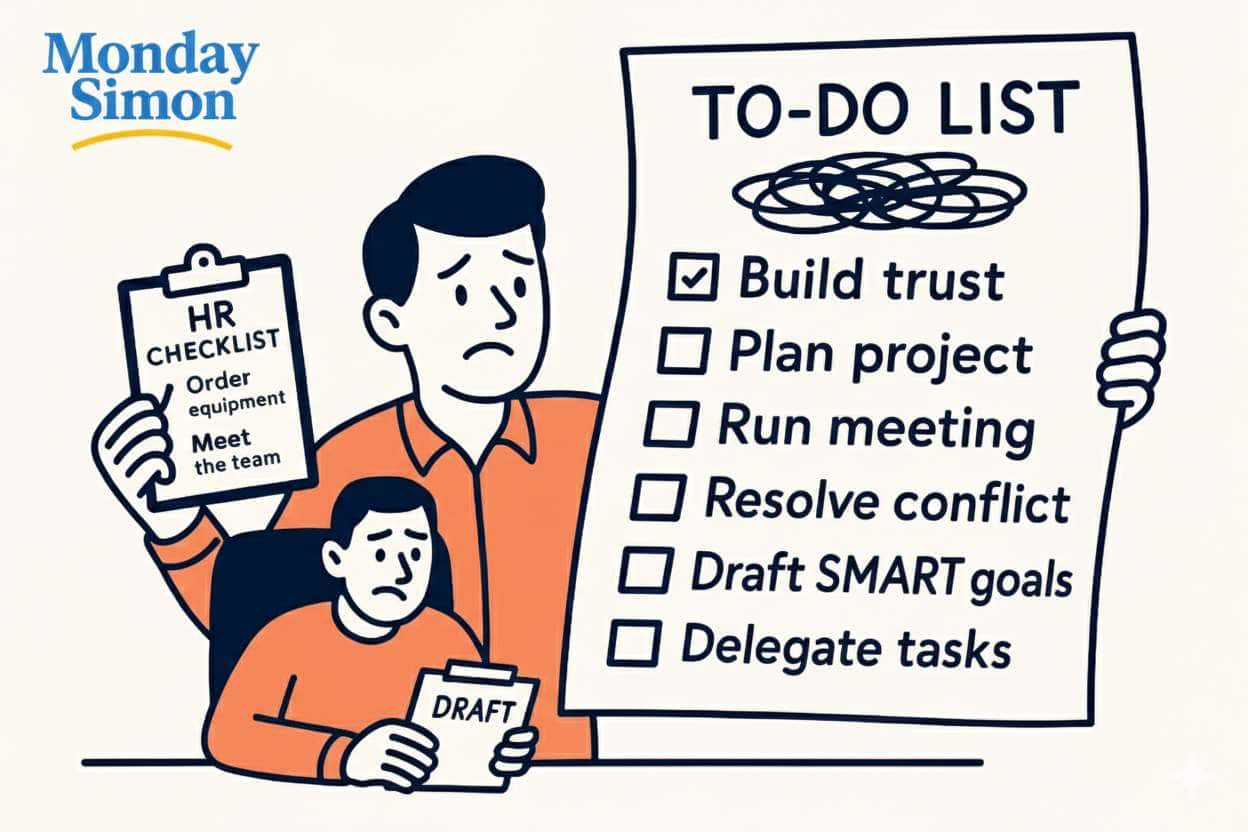
Key takeaways
- Stop Being the “Hero Manager”: Your job has shifted from doing the work to enabling it. Create a “Stop-Doing List” to delegate operational tasks and resist the urge to jump in and save the day. Solving everyone’s problems yourself might feel good, but it leads to burnout and a team that can’t function without you.
- Define “Good” with Your Boss: Don’t play the guessing game. Get written confirmation on exactly what success looks like for your role and the department over the next six months. Without clear, signed-off objectives, you’ll waste your energy firefighting tasks that don’t actually move the needle for your performance.
- Treat 1:1s as Your Credibility Test: Your reputation lives or dies by your consistency. Schedule regular one-on-ones and never cancel them. Use the first month to listen more than you talk, and follow through on every small promise. You make efforts to be a reliable person your team can count on beats being a charismatic talker every time.
- Map the “Real” Org Chart: Before you change a single process, learn the history and the “scars” of the team. Identify the people who actually make things happen and find out what’s truly broken before you try to fix it. Changing things you don’t yet understand is the fastest way to lose your team’s respect.
- Master Upward Communication: You are now the bridge between your boss’s strategy and your team’s reality. Share realistic updates (including the bad news) early and document every key decision. Remember: if it isn’t written down, it didn’t happen. Protect yourself and your team by keeping a clear record of commitments.
Table of Contents
When “Congratulations” Feels More Like “Good luck”
So you’ve just been promoted. HR congratulated you, your boss is happy, and your inbox exploded with “Congrats!” messages. Great.
But then you realize your individual performance alone will not be alone to hit your department’s objectives because yes, you are in charge now.
And in short: Your new team expects answers, your boss expects results, and you’re not sure how to navigate in all this. Welcome to management.
Most new managers make the same mistake: they confuse movement with progress. They rush into decisions, announce changes, hold too many meetings, and think being busy means being effective.
This checklist isn’t about that.
This checklist for new manager is about what actually matters in your first weeks as a new manager. How to build credibility, avoid rookie traps, and set up systems that will make you successful long-term.
Think of this as your survival checklist before you dive into your 30-60-90 day plan.
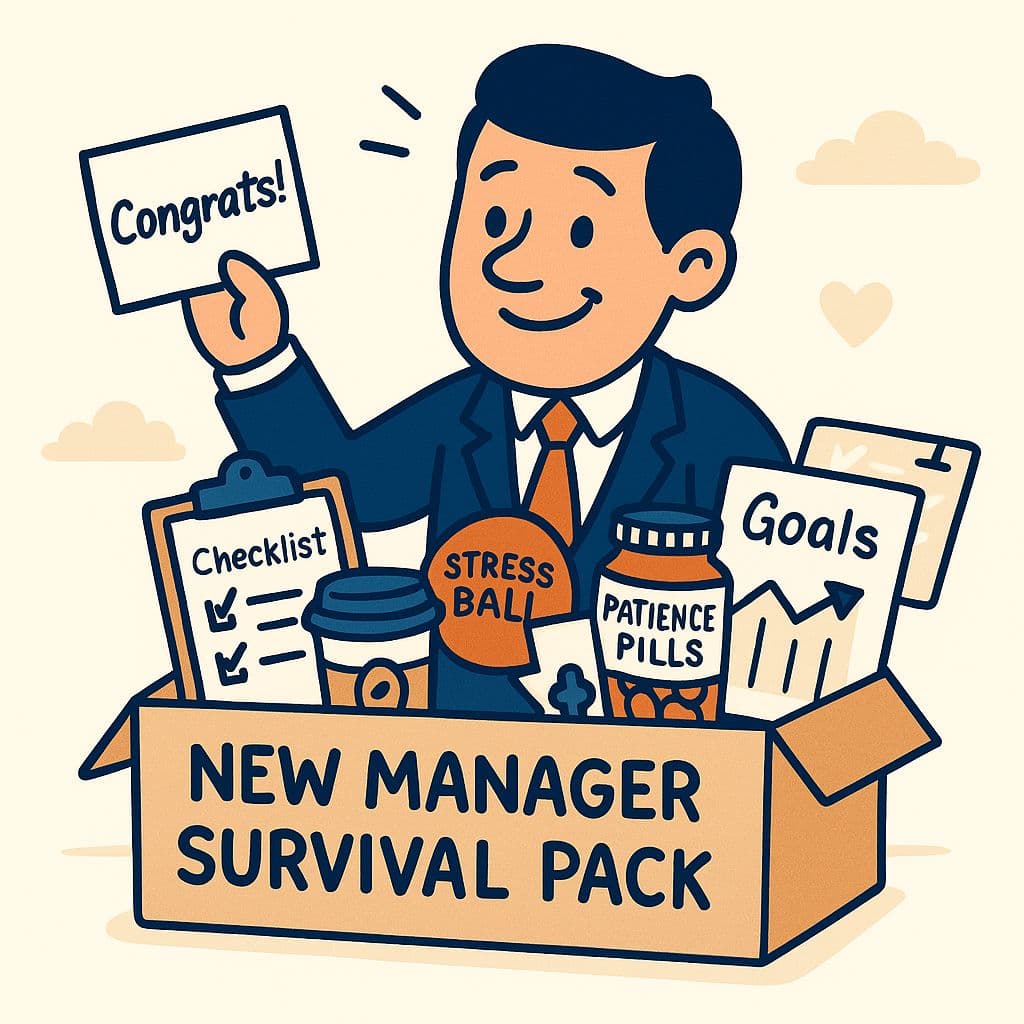
Part 1: Understand What You Have Actually Signed Up For
Before you try to “lead,” understand the job you just inherited.
1. You have moved from “doing” to “enabling”
The biggest shock for new managers is realizing that success is no longer about their personal output. Your job now is to create conditions for others to succeed.
If you were promoted because you were a high performers, your instinct will be to fix everything yourself. Do not do this.
Common trap of what I call the “Hero Manager”: “Hero Manager” saves others and brings solutions by themselves. This is the most recurring trap of the new manager. On one hand, it feels good because your team loves that you do their job when it gets complicated. But this is not viable long-term. You just end up burnt out, resentful, and micromanaging.
You might want to know what type of manager are you. Read the types and fill in the quiz.
New Manager Checklist Item #1: Define Success for Your Team (Not You)
Actions:
- Ask your boss: “How will you measure my success of my role?”
- Get clarity on: “What are the top three objectives to achieve in my first 6 months – one year?”
- Ask: “What does good look like here?”
- Ensure it is written down and signed off
Why this matters: Too often managers downplay the probation objectives. But then they become very meaningful at year end, or in difficult situations. Get clarity now.
Be careful here: You need to elevate the discussion. What I mean is that you want to understand how you will be personally assessed, but since you have a team now, you also need to understand the expectations for your entire department. Otherwise, you are stuck in an individual contributor role plus the burden of every single KPI of your department being measured against your own contribution. Ensure you get the overall picture.
Output:
- Written confirmation of your personal success criteria
- Clear understanding of department-level expectations
- Alignment between your role and team objectives
New Manager Checklist Item #2: Create Your “Manager Stop-Doing List”
Actions:
- List everything you currently do operationally
- Identify what you should delegate versus what you keep doing (Are you sending reports yourself? Are you facing all inquiries directly?)
- Review your agenda and scrap the operational tasks that do not move the needle
- Keep the essentials and force yourself to identify new strategic work
Important: Make the list. Do not act on it yet. Measure what you are going to do before making changes.
Output:
- Clear list of tasks to delegate
- Identified operational work that can be transferred
- Time freed up for actual management work
2. Understand Your Authority and Influence
You are managing people, but you are also managing expectations, politics, and priorities. If you do not clarify these early, you will find yourself firefighting tasks that do not matter.
Often managers think they have the influence they “deserve.” Sometimes rightly so. But in reality, they do not. And vice versa.
New Manager Checklist Item #3: Identify your decision boundaries
Actions:
- Clarify what you can decide versus what you need approval for
- Determine: Can you recruit, terminate, or promote freely?
- Confirm: Are you accountable for the budget?
- If you work for a large organization, map the matrix of functional managers and global headquarters who will champion (or block) your decisions
Can you really just get things done all by yourself? Probably not. Your manager might still be validating key decisions.
Output:
- Written list of decisions you own
- Clear escalation process for decisions requiring approval
- Understanding of political landscape and stakeholders
New Manager Checklist Item #4: Map Your Real Influencers
There is what’s written on paper, and the people who actually “make things happen” in the company. Some might just be your friends, some might not. Regardless, you need to have a clear understanding of who can support or block your responsibilities so you can better play by the rules.
Actions:
- Identify who really influences your team’s success (often not in your org chart)
- List them in your personal notes and take it home with you
- Prioritize coffee breaks and informal meetings with every single person on that list
Every company has the “real org chart” (the people who make things move) and the “official org chart.” Please know both.
Output:
- List of key influencers and stakeholders
- Schedule for connecting with each influencer
- Understanding of informal power structure
3. Learn the History Before Changing Anything
The fastest way to lose credibility as a new manager is to change things you do not understand.
People have scars. Processes exist for reasons (even bad ones). Ask before judging.
Give yourself a time period for diagnosis. This period depends on companies. Some companies may allow you a few months to make your own diagnosis, but frankly these companies are rare. In reality, you are given just a few weeks. After all, you are supposed to already know your work environment (this is what they think anyway).
New Manager Checklist Item #5: Conduct Your Diagnosis Quickly
Actions:
- Ask your team: “What is working well and what is broken?”
- Review team results from the past year (trends reveal blind spots)
- Understand previous managers’ style (your team will still compare you)
- Document what has been working well and what has not
Important: Understanding previous approaches does not mean you should do the same. It means you need to know what worked and what did not before making changes.
Output:
- Team assessment of current state
- Historical performance data reviewed
- Understanding of team expectations based on previous management
Part 2: Build Credibility (Fast)
You cannot lead people who do not trust you long term. So ensure you are set to win your team by applying your “own touch”. My point of view here is that even if you have your own touch, be consistent.
4. Earn Trust Through Presence, Not Promises
Most new managers overpromise to impress. I get it. We want to look good and justify the salary increase. But do not burn yourself so fast.
Instead, focus on being available, consistent, and curious. You do that by implementing one-on-ones that are non-negotiable in your agenda.
You do not need to be everyone’s friend. You do need to be someone people can rely on.
New Manager Checklist Item #6: Establish Non-Negotiable One-on-Ones
Actions:
- Schedule regular one on one with each team member
- Never cancel them (this is your credibility test)
- Listen more than you talk (especially in month one)
- Follow up on commitments, even small ones
- When you do not know something, say so (people respect honesty over polish)
Script example: “I do not have the full answer yet, but I will check with [X] and come back to you tomorrow.”
That line does more for your credibility than any motivational speech. Especially if you say you will do something and then you actually do it.
Output:
- Understanding of where each team member is versus their responsibilities
- Clear view of development needs
- Identified blockers and where your help is required
- Maintained authenticity (you do not say yes to every request)
New Manager Checklist Item #7: Map Your People
Before you develop anyone, know who you are managing.
Every team has its mix: the steady rock, the quiet expert, the loud complainer, the hidden star. Your job is not just to label them (though it actually helps to label them). It is to understand what drives or blocks them.
Actions:
- Create a 9 box grid: Performance versus Potential
- Identify each person’s motivation (status, growth, purpose, stability)
- Ask each person: “What does success look like for you this year?”
- Find your culture carriers (they will help you stabilize the team)
Output:
- Understanding of team development areas
- Knowledge of what makes each person stay or leave
- Clear view of how you can help with the resources and time you have
5. Communicate the Plan
As a new manager, silence is your enemy. If people do not know what is happening, they will assume the worst. Also, you are setting objectives for the team. Time to tell them where to go.
New Manager Checklist Item #8: Share Direction and Updates Regularly
Actions:
- Share updates even when there is “nothing new” (weekly operational team meetings are made for that)
- Explain the direction clearly
- Explain why decisions were made (builds transparency)
- Use simple, repeatable messages (consistency builds alignment)
Example: “We are focusing on fewer projects this quarter so we can finish strong on the ones that matter. We are focusing on A, B, C.”
Output:
- Objectives reviewed and communicated with your input
- Action plan developed with the team
- Team alignment on priorities
Part 3: Understand Your Team Before Trying to Fix It
6. Clarify Roles and Expectations
Unclear roles cause more conflict than personality differences ever will. You have met your team and you understand their roles. Since you know the objectives, align them.
New Manager Checklist Item #9: Review and Redefine Roles
Actions:
- Review everyone’s job description (half might be outdated)
- Redefine roles using action verbs: “owns,” “leads,” “supports,” “decides”
- Communicate any changes clearly (do not surprise anyone)
- Ensure objectives are actually reflected in job descriptions
This is a quick win: You are seen as someone supporting their objectives when these are not aligned.
Output:
- Updated role clarity for each team member
- Alignment between objectives and job descriptions
- Clear accountability structure
New Manager Checklist Item #10: Spot Early Warning Signs of Trouble
You do not need to be a psychologist to spot trouble in a team. As a new manager, you want to understand the signs you will tolerate and the ones you will not. For instance, you would not want the best people to leave while you are just stepping in.
Actions:
- Watch for silence in meetings (that is not agreement, that is fear)
- Notice overdependence on one person (signals burnout risk)
- Track missed deadlines or rising tension (address it early)
- Do not avoid difficult talks (they only get worse)
Mini-script: “I noticed you have seemed frustrated lately. Is there something blocking you at work?”
That sentence can prevent a resignation.
Output:
- Understanding of who is at risk (performance or behavior mismatch)
- Clear view of high performers
- Your role to mitigate, correct, or intervene
Part 4: Set Up Your Management Systems
Consistency beats charisma. Period.
It is best to be identified as a reliable value that people can count on rather than a super charismatic person who is “good at talking”. But do not get me wrong: it is better to have both. But if you had to choose, choose consistency.
7. Establish Your Weekly Rhythm
Your calendar is now your management system. If it is chaotic, your team will be too.
New Manager Checklist Item #11: Block Your Management Time
Actions:
- Schedule a weekly team meeting to align priorities
- Protect one-on-one time to support your team and address performance and development
- Create an “open door” slot to stay approachable
- Block time for yourself for focus and recovery
Managers who do not manage their time always end up managing crises. Do not be the crisis manager. There are already too many of those in organizations. Crises are to be prevented so you do not work extra hours and you get better recognition for it.
Output:
- Structured weekly calendar
- Protected time for strategic work
- Predictable availability for your team
8. Give Feedback Early, Not Perfectly
Waiting for the “right time” to give feedback usually means you will never give it.
New Manager Checklist Item #12: Implement Monthly Feedback
Actions:
- Give feedback at least monthly (you can give it weekly, but not quarterly and especially not yearly)
- Use the FIAC Feedback method (Fact – Impact – Ask – Continue)
- Praise effort publicly, correct issues privately
- Always link feedback to business outcomes
FIAC Example: “When you skipped the update, the team could not close the report (Fact). It delayed the customer response (Impact). What happened? (Ask). Let’s agree to update before 3pm next time (Continue).”
Output:
- Regular feedback rhythm established
- Team members understand performance expectations
- Problems addressed before they escalate
New Manager Checklist Item #13: Review Team Objectives Against Reality
Actions:
- Review existing team KPIs and OKRs
- Confirm relevance with department objectives
- Identify gaps or misalignments
- Adjust as needed with stakeholder input
Output:
- Team objectives aligned with department goals
- Clear priorities for the quarter
- Measurable targets for each team member
MORE MANAGER DEVELOPMENT RESOURCES
This article is part of our manager development resources.
Part 5: Manage Yourself (Before You Manage Others)
9. Do Not Expect to “Feel Ready”
Every manager starts with impostor syndrome. You will think, “I am not qualified for this.” That is normal.
Leadership confidence is not a switch. It is a pattern of small wins. You need to acknowledge that discomfort is part of growth. Identifying a win is key to ensure you build confidence and that you do not overwhelm yourself.
New Manager Checklist Item #14: Identify Your Quick Wins
Actions:
- Do not fight all battles right away
- Identify 1-2 quick wins you can achieve in the first 30 days
- Focus on visible improvements that build credibility
- Celebrate these wins with your team
Output:
- Confidence built through early successes
- Credibility established with tangible results
- Momentum for larger initiatives
New Manager Checklist Item #15: Find Your Management Support System
Actions:
- Identify a mentor or peer to discuss challenges
- Connect with someone who has been there before
- Schedule regular check-ins for advice and perspective
- Build your network of fellow managers
Having return of experience from people who have been there is key. Ensure this is in place.
Output:
- Support system for difficult situations
- Access to experienced perspective
- Reduced isolation as a new manager
10. Manage Up, Not Just Down
You are now a bridge between your boss and your team. That means you manage in two directions. To be real, you need to be very vocal about wins, but you also need to be transparent about bad news as well.
New Manager Checklist Item #16: Establish Upward Communication Rhythm
Actions:
- Share realistic updates with your boss (do not hide bad news)
- Ask for feedback early (do not wait for performance review season)
- Ensure wins are communicated to the people who matter the most (not just your boss)
- Translate strategy into simple language for your team
Output:
- Strong relationship with your manager
- Clear communication channel upward
- Team protected from unnecessary chaos
New Manager Checklist Item #17: Document Your Decisions and Commitments
Blabblabla. Some managers love to hear them talk. Here, you want to ensure your communication lands. So to be sure, document common decisions and actions plans, because it creates accountability.
Actions:
- Keep written records of key decisions
- Document commitments you make to your team
- Track follow-through on your promises
- Maintain a simple log of what you said you would do
Why this matters: If it is not written, it did not happen. Protect yourself and your team with documentation.
Output:
- Clear record of decisions and rationale
- Accountability for your commitments
- Protection in case of disputes
New Manager Checklist Item #18: Set Boundaries Early
You are in charge of setting the standards in your team. I like to think that the team is like your mini culture. Sure, you apply the group guidelines, but there is also how you want to operate. And here, ensure it is well understood by them
Actions:
- Establish when you are available versus when you are not
- Be clear about what is acceptable VS what is not (performance and behaviors)
Output:
- Sustainable work pattern
- Clear expectations for team availability
- Culture of effectiveness over presenteeism
New Manager Checklist Item #19: Build Your Manager Toolkit
Actions:
- Familiarize yourself with company performance management processes
- Understand how to access HR support and resources
- Learn the systems for goal-setting, feedback, and development
- Ensure you have templates for one-on-ones, performance reviews, and development plans
The four tools you need:
- SMART Goals and KPIs (Performance Management)
- Individual Development Plans (Learning and Development)
- One-on-One Conversations (Feedback, Coaching, and Mentoring)
- Performance Management System (The Annual Cycle)
Output:
- Access to necessary management tools
- Understanding of company systems and processes
- Readiness for performance management cycles
New Manager Checklist Item #20: Plan Your First 90 Days
Actions:
- Create a simple 30-60-90 day roadmap
- Identify key milestones for each phase
- Share your plan with your boss for alignment
- Review and adjust monthly based on what you learn
30 Days: Listen, learn, and build relationships 60 Days: Identify priorities and quick wins 90 Days: Execute on initial improvements and set longer-term direction
Output:
- Clear roadmap for your first quarter
- Alignment with your manager on priorities
- Confidence in your direction
You Do Not Need to Be Perfect. You Need to Be Consistent
The truth is, nobody is ready for management, and it’s a shift.
The best new managers are not the loudest, smartest, or fastest. They are the ones who take the time to learn, listen, and adjust.
So before you rush into your 30-60-90 day plan, start here. Print this new manager checklist. Keep it visible. Because leadership is not built in one big move. It is built one small, consistent action at a time.
The best managers are made on Monday morning.
Download Your New Manager Checklist
Ready to put this into action? Download the complete new manager checklist with all 20 action items, outputs, and implementation timeline.
This checklist gives you:
- All 20 checklist items in a printable format
- Clear outputs for each action
- Space to track your progress
- Timeline recommendations for your first 90 days
Download the New Manager Checklist PDF
Want more support for your transition into management? Check out our New Manager Training Program for comprehensive guidance on mastering the fundamentals of people management and don’t miss our Ultimate Guide for New Manager for additional insights you can apply right away.
Stay sharp for Monday
Practical resources to help managers lead smarter, faster, and with confidence.

Free manager resources for new Managers
View Article
The Ultimate Guide for The New Manager
View Article