Key takeaways
- Audit the Reality: Move beyond subjective feedback and use a Manager Capability Scorecard to create a binary audit. You cannot improve what you do not measure, so establish a baseline to see if behaviors are actually happening or if they are just theoretical.
- Bridge the Implementation Gap: Recognize that most organizational failures are not HR strategy problems, but execution issues. Shift focus from designing perfect frameworks to ensuring managers view processes (like 1:1s and scorecards) as essential trade tools rather than administrative burdens.
- Match Support to Maturity: Abandon one-size-fits-all training. Enforce strict behavioral audits for “Operational Liabilities” (Score 0-16), run 90-day consistency sprints for those with “Inconsistent Execution,” and use targeted calibration for managers who just need specific polishing.
- Elevate, Don’t Train: For example if the scorecard reveals “High Potential” managers (Score 49-64), avoid basic compliance training that leads to disengagement. Instead, invest in targeted support such as ICF Executive Coaching to refine your manager’s strategic influence and utilize them as internal mentors to model excellence for the rest of the organization.
Table of Contents
Every HR leader wants to know if their managers are truly ready to lead. Yet, we often rely on subjective feedback “the team likes her” or “he drives results” rather than objective data. The Manager Capability Scorecard is designed to have a fist look at your manager maturity level. By scoring operational consistency, it helps you decide whether your organization needs to focus on foundational competence or advanced leadership development.
Why a Manager Capability Scorecard?
You cannot improve what you do not measure. HR leaders often struggle to justify training budgets or prove the ROI of L&D because they lack a tangible baseline for leadership maturity. This manager capability scorecard is a first mini diagnosis to understand that gap. It transforms vague leadership concepts into a binary audit: either the behavior is happening, or it isn’t. By establishing a clear numerical score, you get an overall overview of your manager’s maturity in your company, and which “group” action should be prioritized.
The Implementation Gap: Why Managers “Know” But Don’t “Do”
There is a common misconception that pushes the blame onto HR for every systemic failure in an organization. But more often than not, you don’t have an HR strategy problem; you have a manager implementation problem.
Click here to read my article about the most recurring HR issues due to manager implementation.
We can always spend months designing perfect frameworks : standardized IDPs, structured interview guides, and performance management cycles. Yet, Monday morning arrives, and managers ignore them. They hire based on gut feeling, skip 1:1s when busy, and treat development plans as an annual paperwork exercise.
Why does this happen?
- Promoted for Performance, Not Management: Most managers reached their position because they were great individual contributors. They view “HR processes” as administrative hurdles that distract from their “real work,” rather than the essential tools of their new trade.
- Lack of Consequences: When a manager hires the wrong person because they skipped the recruitment scorecard, or when a high-performer quits because they never received feedback, there is rarely a consequence for the manager. The cost is absorbed by the organization.
- Theory vs. Reality: Managers understand the theory of the recruitment process, an IDP (Individual Development Plan), or performance management, but they lack the coaching habit to execute it. They know they should do structured interviews, but in the heat of the moment, they improvise.
Take 5 minutes to complete the questionnaire of the manager capability scorecard:
This short assessment is based on a documented Manager Capability Scorecard framework focused on observable management behaviors.
1. The Operational Liability (Score 0-16)
The Diagnosis: This is the “Red Zone.” Managers here are bypassing core processes entirely. They view management duties as a distraction and often blame HR or “lack of resources” for their team’s failures.
- The Behaviors: Zero documentation. Blaming external factors. Hiring based on “gut feeling”. Avoiding difficult conversations until they become crises.
- The Organizational Risk: High compliance exposure. If managers don’t document performance, you cannot manage low performers out.
The Fix:Mandatory 6-Month Behavioral Audit. This is not a training issue; it is a manager fundamental issue. You need to enforce control and Grade managers against their managerial duties.
2. Inconsistent Execution (Score 17-32)
The Diagnosis: The “Stop-Start” Culture. These managers understand the basics but lack the consistency to maintain them.
- The Behaviors: They run 1:1s, but only when there is a fire to fight. They set goals at the start of the year but forget to track them until Q4. They treat recruitment as an admin task rather than a strategic one.
- The Organizational Risk: Inefficiency. Your teams are running in catch-up mode, wasting organizational energy on realignment rather than execution.
The Fix: A 90-Day Output Sprint. These managers don’t need reminders of the fundamentals and a rhythm. A 90-day sprint focuses on building muscle memory. The goal is simple: implement a managerial system and provide feedback on the outputs. At the end of the 90 days, have them build on repeat, this time with minimal support.
3. Calibration Required (Score 33-48)
The Diagnosis: The “Solid B” Organization.
- The Behaviors: The mechanics are there. Meetings happen, feedback is given. However, quality varies between departments. Sales might be great at feedback, while Engineering is vague. They fill out the IDP, but the goals are vague (“improve communication”) rather than actionable.
- The Organizational Risk: Performance Plateau. The company is good, but will never scale to great because the management layer lacks the precision to elevate teams uniformly.
- The Fix: Targeted Modular Support. Don’t waste time on basics. Focus on high-leverage calibration. The advice here is to run an assessment to focus on the gaps that are required, and coach on specific gaps to help them improve and reach the bar of satisfactory managerial standards, for the ones who need it.
4. High Potential (Score 49 – 64)
The Diagnosis: The Future Executive Bench.
- The Behaviors: These managers are role models. They document decisions, coach their people using structured frameworks, and build succession pipelines. They treat management as a profession.
- The Organizational Risk: Retention. If you treat these high-performers like the “Operational Liability” group by forcing them into basic compliance training, they will disengage.
The Fix: ICF Executive Coaching. Stop training them and start elevating them. Use them as internal mentors to model “what good looks like” for the rest of the organization. Invest in their ability to think strategically, not just operationally. Here a high level coaching makes sense. Not on the fundamentals, but on higher level development leadership outputs with overview support from an ICF coach.
How Monday Simon Manager development program supports your managers
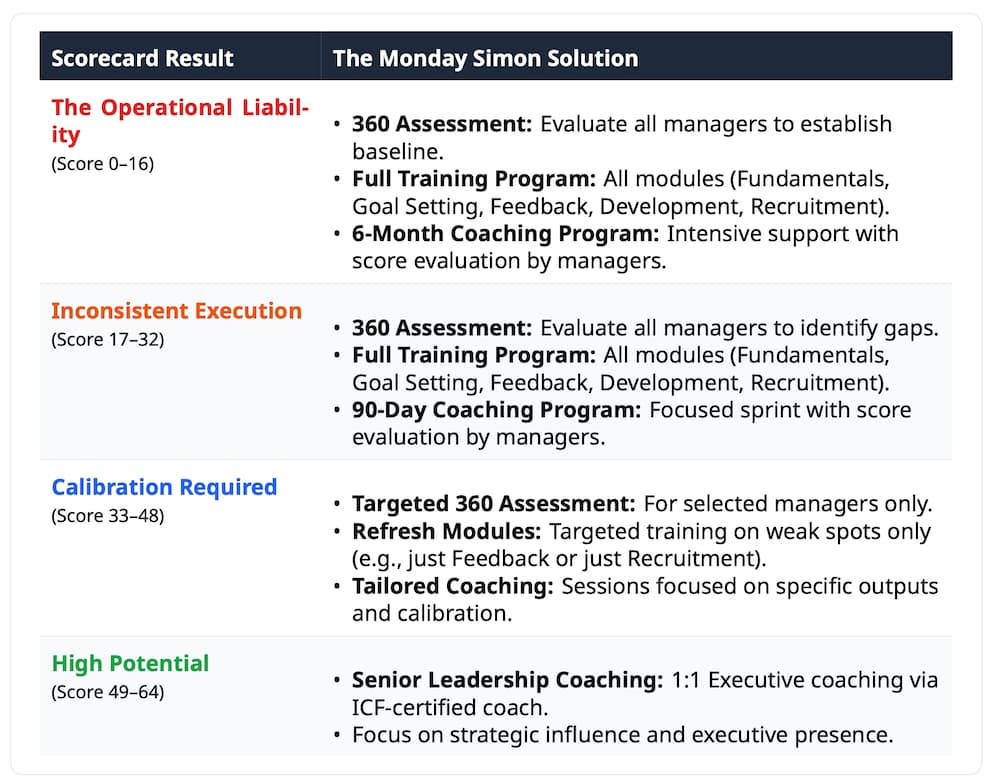
We are entering a period where efficiency is king. Companies can no longer afford to carry the weight of inefficient management layers where HR strategies go to die. Below is the application of the Monday Simon Manager Development Program VS the current managerial level in your company:
The approach:
To maximize ROI and engagement, Monday Simon tailors interventions based on manager capability rather than a one-size-fits-all approach.
For managers scoring in the Operational Liability (0–16) and Inconsistent Execution (17–32) zones, the focus is on standardization and compliance through a full training program paired with rigorous coaching tracks (6 months and 90 days, respectively) to build essential habits.
For those in the Calibration Required (33–48) tier, the strategy shifts to precision, utilizing targeted refresh modules and tailored coaching to fix specific quality gaps without redundant training.
Finally, High Potential (49–64) leaders are elevated through specialized ICF executive coaching focused on strategic influence, ensuring retention and grooming them for future senior leadership roles.
Take the next step
Let’s discuss your Manager Development Program together.
We’ll review your objectives, expected outcomes, and the support your managers need for a sustainable impact.