
Key takeaways
The Structured interview is part of Monday Simon Manager Development Program: 👉 Module 6:Recruitment in practice.
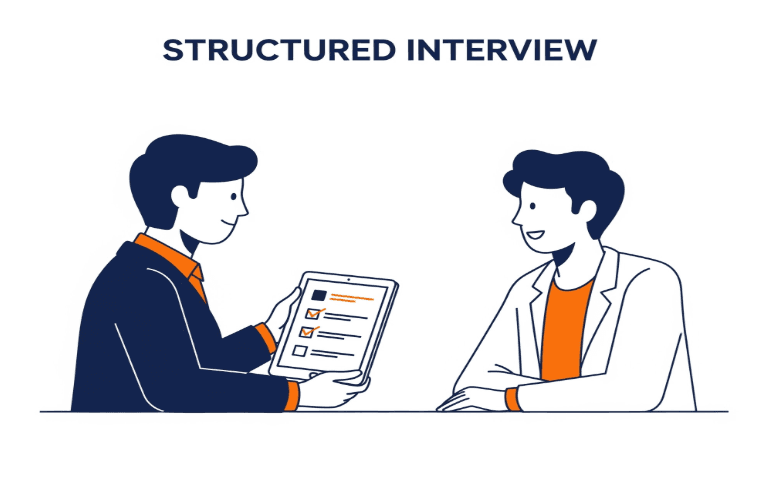
When interviews turn into “nice conversations” and remain at the surface level, everyone leaves feeling good until the wrong person shows up on Monday and productivity drops. This is why structured interviews exist.
What is a Structured Interview
A structured interview is a disciplined method where you ask every candidate the same job-relevant questions in the same order, then score their answers using a predefined rubric. It's a systematic, repeatable, and data-driven process designed to compare candidates objectively rather than emotionally.
Structured interviews aren’t unique to HR. The same logic is used in research and market studies to collect consistent data. In hiring, this structured interview helps you detect patterns in behavior, spot blind spots, and make decisions supported by evidence instead of intuition. A structured interview is the recipient to additional questioning methods, such as theSTAR interview method.
There are three broad interview formats:
If you are serious about improving hiring accuracy, structured interviews are your baseline.
When to Use The Structured Interview
My advice is to apply a structured interview at every single interview to limit bias. Use the structured interview approach especially for the following cases:
The structured interview also helps to “come prepared” in the interview room with minimal time for preparation, because the structure is always the same.
The Blueprint for a Structured Interview
The preliminary step to structured interviews is to have clearly identified the key requirements of the role in yourrecruitment scorecard. So here are 3 easy steps for implementation:
Create your scorecard
The scorecard lists the mandatory requirements for the role. The scorecard can list the keycompetenciesand the mandatory items for the candidate selection. Here, identify the top non-negotiable skills or behaviors for success in the role. Avoid vague words like“team player.”Instead, write measurable behaviors such as:
Every question you ask must tie directly back to one of these identified competencies. You can generate questions to prepare for your interview by using my customChatgpt for interviews.
Standardize the questions
Switch from hypothetical to behavioral questions. Future behavior is predicted best by past behavior. Stop asking “What would you do if…?” and start asking “Tell me about a time when…”
Example: Don't: “How would you handle a demanding client?” Do: “Tell me about the last time a client pushed back hard on your deliverable. What did you say, and what was the result?”
Important: Use the exact same wording and order for each candidate. This ensures your comparison is apples-to-apples, not impressions-to-vibes.
Create an objective scoring rubric
Immediately after the interview, score responses using a simple scale. This simple scale is nothing less then what's written in your recruitment scorecard. The rating scale can present like this:
Why Structured Interviews Drive Business Results
Structured interviews are essentially a business protection system because they remove bias and gut feeling. I strongly recommend managers to adopt structured interviews, as they lead to :
Structured interviews also make it easier to analyze results over time. You can spot which questions best predict on-the-job success and continuously improve your process.
Competency-based Interviews: How is it Different?
A competency-based interview is simply a structured interview focused specifically on skills, knowledge, and behaviors. We also call it thebehavioral interview. Here you are assessing how a candidatedemonstratescompetencies such as:
These competencies must connect directly to the job’s core deliverables, not to “personality fit.”
Example: Customer-orientation Competency
Below are sample behavioral questions you can plug directly into your structured interview for a “Customer Orientation” competency:
Each question maps to a specific behavior, making your scoring consistent across interviews.
How to Apply This on Monday morning
If you want ready-to-use templates and rubrics, visit theManager Toolspage.
MORE MANAGER DEVELOPMENT RESOURCES
This article is part of our recruitment resources.
Stay sharp for Monday
Practical resources to help managers lead smarter, faster, and with confidence.


