Key takeaways
- Master the Mechanics First: You cannot lead effectively if you can’t manage. Prove you can set goals, give feedback, and get things done before you try to inspire a movement. Leadership without management is just empty noise.
- Know When to Switch Hats: Use your manager hat to stabilize and control during a crisis, but switch to your leader hat to drive change and transformation. The best “managers who lead” know exactly which approach the moment requires.
- Move from Control to Trust: Stop monitoring every move and start providing clarity and space. If your team only executes when you’re watching, you’re just a supervisor; if they take initiative when you’re gone, you’re a leader.
- Connect Performance to Purpose: Shift from “How and When” to “Why and What if.” Don’t just hit targets; remember to link the daily grind to a bigger mission to move your team from simple compliance to genuine contribution.
- Coach for Independence: Instead of jumping in to fix every problem, use coaching questions to help your team think for themselves. Your goal is to build a team of successors who can deliver value without needing you to pull the strings.
Table of Contents
Difference Between Manager and Leader: Why Managers Need to Care About Leadership (And Vice Versa)
I know you don’t wake up thinking, “I’m going to be a great leader today.” You’re probably wake up thinking, “I’ve got five meetings, three problems to fix, and a deadline that should’ve been done yesterday.”
You get things done. You solve problems. You make sure the work keeps moving. That’s management and it’s essential.
But then there is Leadership. The ability to make people want to follow you. To inspire, not just instruct. To create momentum that lasts even when you’re not in the room.
And that’s where most managers hit a wall. Because to my knowledge it is rare to see companies that clearly teaches you where management ends and leadership begins.
So let’s cut the buzzwords and get real about the difference between managers and leadership. You don’t need to be Steve Jobs. You don’t need to give TED Talks. But you do need to understand what separates the two, for the sake of doing it well.
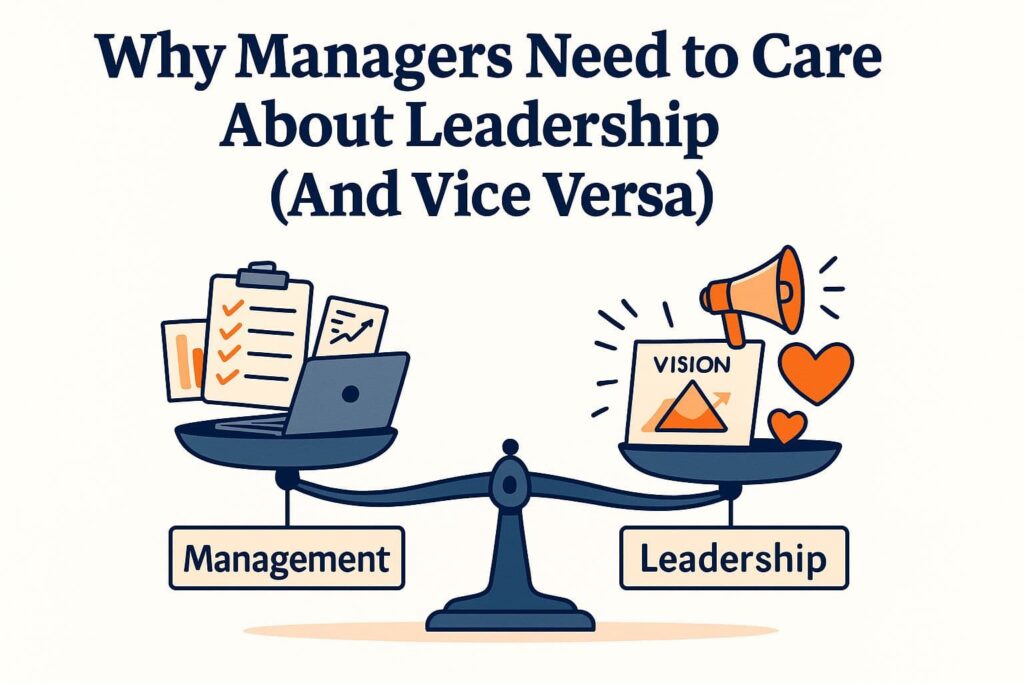
The Real Difference Between Manager and Leader (Without the Buzzwords)
For years, companies have mixed up management and leadership like they’re the same job. They’re not.
We promote high performers into management roles thinking their technical expertise will automatically make them great leaders. Then we’re surprised when those same people burn out their teams or fail to inspire change.
We send managers to “leadership bootcamps” to learn vision, storytelling, or coaching but then we measure them on cost savings and headcount efficiency. No wonder why it is confusing to know the difference between manager and leader.
The truth is, management and leadership are two completely different muscles. You need both. But they do very different things. This confusion comes from misunderstanding the difference between manager and leader, and assuming both roles require the same skills.
And here’s what most people miss: you can be both a manager AND a leader. In fact, the best ones are.
The same person who builds systems and tracks KPIs and OKRs can also inspire vision and empower their team. It’s not either/or; it’s knowing when to switch between the two and mastering both skill sets.
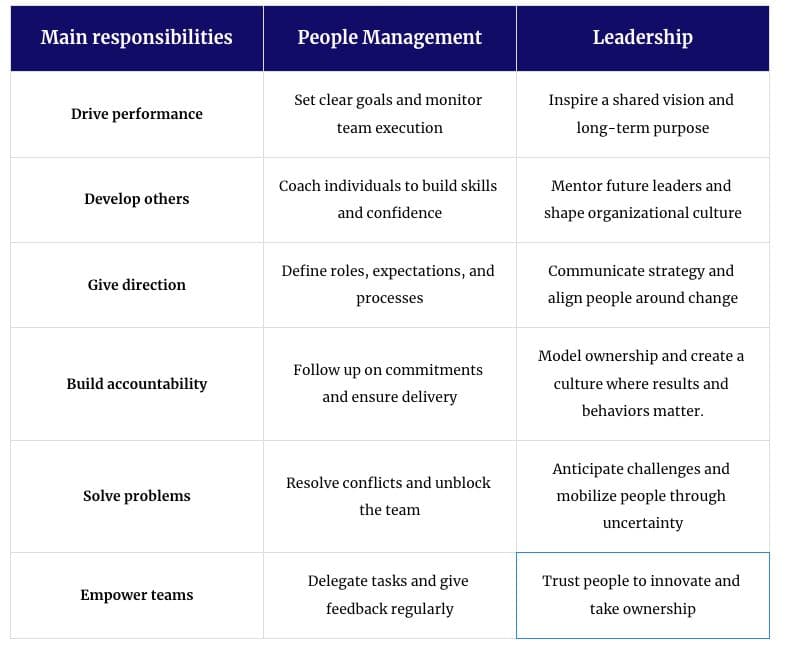
Below is a brief difference between the manager and the leader
What Managers Actually Do
Let’s start with the basics. Your job as a manager is to make work happen. Predictable, repeatable, measurable work.
The Manager’s Mindset
As a manager, you think in systems. You focus on structure, clarity, and output. Your language is about efficiency: “When, how, who, how much?”
You ask:
- Are we on track?
- Are resources allocated correctly?
- Are people developed to meet expectations and career paths?
- Are we hitting the KPI?
A great manager doesn’t need to give motivational speeches, assuming you have built systems where things work, even when you are not in the room.
When things go wrong, you fix it, quickly.
The Daily Reality
From my experience the contraction of the manager is to be stuck between two worlds: your boss wants results, and your team needs support. You must translate strategy into execution.
Without good managers, organizations collapse into chaos. Without good leaders, they die slowly from apathy.
What Leadership Actually Looks Like
This is where the difference between managing and leading becomes clear.
Leadership is not a title. It’s energy and the constant delivery of this energy. Leaders don’t push, they pull.
They build trust, shape meaning, and give direction when others feel lost. They don’t only manage the what and how, they focus on the “why”.
The Leader’s Mindset
As a leader, you think on purpose. You care about direction, values, and growth. Your language is about belief: “Why does this matter? Who do we want to become?”
You ask:
- What future are we building?
- How can I empower others to take ownership?
- How can we grow beyond what’s expected?
While managers deliver consistency, leaders drive change. You don’t just ensure the machine runs you redesign it when needed. This is where the difference between manager and leader becomes clear: managers create consistency, leaders create direction.
A Leader’s Toolbox
- Vision: setting a clear, compelling direction
- Inspiration: communicating it with authenticity
- Empowerment: trusting others to deliver in their own way
- Courage: making hard calls when no one else dares
- Empathy: understanding what people feel, not just what they do
These skills are harder to measure but critical to long-term success. You can meet all your targets and still fail if no one wants to follow you.
What Is the Real Difference Between Managers and Leadership?
Here’s the bottom line on management vs leadership:
Managers focus on:
- People, Process and systems
- Execution to get sh*t done
- “How and when?”
- Delivering predictable results
Leaders focus on:
- Purpose and vision
- Long-term transformation
- Inspiration and trust
- “Why and what if?”
- Driving change and growth
Don’t get me wrong, great managers do both and know when each question fits the moment.
Why Do Companies Keep Getting This Wrong?
Organizations love managers because they bring order, they bring direction and their ability to get shit done. But they rarely reward both equally.
We still promote based on control and output, not inspiration and trust. We say we want innovation, but punish risk-taking. We say we value people, but reward numbers. And to play devil’s advocate, I admit it’s harder to measure “Company vision” rather than “Sales revenue”, granted.
Overall, organizations are pushing towards managers who can build short term predictable results, not leaders who inspire long term goals.
That’s why some of the best leaders never had “manager” titles. They were just the ones everyone listened to in the room. The CEO does not have sole ownership of the ability to lead. This ability is, in fact embedded in everyone’s role if the company allows it.
The Danger of Over-Managing
Personally, I think Leadership is very often over-hyped. Because everyone uses the term leader without really setting the expectation. However, I am convinced about the benefits of Leadership. And when management dominates leadership, everything becomes transactional. You get:
- Meetings about meetings
- Reports that nobody reads
- Team members who execute without thinking
Work becomes about compliance, not contribution.
A pure manager can fall into the trap of driving output, but kill initiative. They risk creating dependents, not successors.
And when people only do what they’re told, they stop caring.
The Danger of Over-Leading
The opposite extreme isn’t better. A pure leader who never manages the details can drive everyone crazy.
They talk about the future but forget today’s priorities. They inspire without delivering. Their teams drown in enthusiasm but lack structure.
Leaders without management discipline create chaos. Managers without leadership energy create stagnation.
You need both, but not in equal doses all the time. Obviously, the job title helps to limit the fair repartition of both but come on, we have all noticed some senior leaders who have stopped delivering and only become disconnected from realities and spend their days creating power points that are not moving the needle, at all.
Manager vs Leader: When to Use Each Approach
In a crisis, you need to be a manager: someone who stabilizes, tracks, and controls. In transformation, you need to be a leader: someone who inspires, aligns, and takes risks.
The art is knowing when to switch hats.
Practical Example: Turning Chaos Into Clarity
Imagine your company just lost a key client. Revenue is down. Tension is high.
Your manager instinct is to fix the process:
- Review why the client left
- Reassign sales targets
- Adjust forecasts
- Tighten reporting
Your leader instinct is to mobilize belief:
- Remind the team of the bigger mission
- Communicate transparently
- Inspire confidence that the team can bounce back stronger
You stabilize as a manager; you re-energize as a leader. Both are essential. One gets things done. The other makes people want to.
And the best part? You can do both. In the morning, you’re reviewing the numbers and adjusting the plan. In the afternoon, you’re sitting with your team and reconnecting them to why this work matters. That’s what great managers who lead actually look like.
You Must Be a Manager First (My point of view)
This is where most leadership advice gets the difference between managers and leadership completely backwards.
Everyone wants to skip straight to “being a leader”: the inspiring speeches, the vision boards, the transformational stuff. The reality is that you cannot lead effectively if you can’t manage effectively first.
Leadership without management is just noise. It’s empty inspiration. It’s the person who talks about the future but can’t organize a simple project meeting.
Think about it. Would you follow someone who:
- Can’t set clear goals?
- Doesn’t know how to develop their people?
- Gives vague feedback that leaves you confused?
- Has no idea how to run a performance process?
Of course not. Because leadership is built on the foundation of solid management.
You need to master the mechanics before you can inspire the movement. You need to prove you can get things done before people will trust you to show them where to go.
Explore my manager development program
5 Complete Modules: Introduction to People Management, Goal Setting, Competency Development, Coaching & 1-on-1s, Performance Management in Practice.
The 6 Core Manager Skills You Must Master First
Before you worry about becoming a “leader,” master these five fundamental management capabilities. This is the real difference between manager and leader. Leaders master management first.
1. Setting SMART Goals and Objectives You can’t inspire your team toward a vision if you can’t translate that vision into clear, actionable goals. Learn how to break down strategy into objectives people can actually execute.
→ Master goal setting with Module 2: Setting goals and driving results
2. Creating Individual Development Plans (IDPs) Leaders develop people. But first, you need to know how to create a development plan that actually works. Not theoretical career planning. Real skill-building that drives performance.
→ Learn to develop team training through Module 3: Developing team members
3. Giving Effective Feedback Want to inspire? Start by mastering feedback. You can’t coach, mentor, or motivate if you can’t tell someone what they’re doing well and what needs to change. And you need to do it in a way that doesn’t destroy trust.
→ Master feedback techniques in Module 4: Feedback and coaching conversations
4. Leading Coaching Conversations Coaching is where management meets leadership. It’s not just telling people what to do : it’s helping them think for themselves. But you need a framework, not just good intentions.
→ Develop coaching skills in Module 4: Feedback and coaching conversations
5. Running the Performance Management Process Performance reviews aren’t just HR paperwork. They’re your chance to align expectations, recognize growth, and address problems before they explode. Get this right, and everything else gets easier.
→ Learn the performance process in Module 5: Performance management in practice
6. Recruiting the right people
Master these five skills, and you’ll earn the right to lead. Skip them, and you’re just another person with a title who talks a good game but can’t deliver.
How You Actually Grow From Manager to Leader
Once you have built that management foundation, here’s how you make the shift from managing tasks to leading people.
1. From Checklist to Compass
Because you succeeded in laying the foundations of people management, you get a team that delivers without falling into the micro management trap and should have time “back” to yourself. This time is better spent on setting a vision, anticipate the future,
2. From Control to Trust
Managers monitor. Leaders empower. Trust doesn’t mean letting go, it means giving clarity and space.
Ask questions like:
- “What support do you need from me?”
- “How can I help you make the decision yourself?”
It is a common manager’s good practice to be a leader.
3. From Feedback to Coaching
You give feedback: “Here’s what you did wrong.” You coach: “Here’s how you can get better.”
Coaching takes more time, but it builds independence.
4. From Performance to Purpose
When you only measure results, you miss motivation. Leaders link performance to meaning.
Instead of “We must hit target X,” say “This project matters because it moves us toward Y.”
Note : Leadership ability is usually assessed through a 360 assessment to understand a manager’s leadership capability.
The Middle Manager Trap
Middle managers live in the hardest place of all: they are squeezed between strategy and reality. You must manage up and lead down.
You’re told to “empower teams” while following ten layers of approval. You’re told to “be strategic” but measured on operational noise.
For you, understanding the difference between manager and leader is not just about inspiration speeches, it’s more about navigating contradictions.
If you’re in that position, don’t wait for permission to lead. Leadership is not granted. It’s deliberately chosen.
Common Questions About the Difference Between Managers and Leadership
- Can you be a leader without being a manager?
Yes. But it’s informal leadership. You can influence without authority. You can inspire without a title. But if you want to drive sustained change in an organization, you eventually need the authority to make decisions, allocate resources, and hold people accountable. That’s where management comes in.
- Can you be both a manager and a leader?
Absolutely. In fact, that’s the goal. The best managers are also leaders and vice versa. You can run tight operations AND inspire your team. You switch between both modes depending on what the situation needs. One day, you’re deep in the spreadsheet fixing a broken process. The next day, you’re painting the vision that gets everyone excited to push through a tough quarter. Same person, different hats.
- What’s the main difference between a manager and a leader?
The main difference between manager and leader comes down to focus: managers optimize what exists (People, processes, efficiency, execution), while leaders create what’s next (vision, change, growth). But the best people do both.
- Do you have to be extroverted to be a leader?
Hell no. Some of the best leaders I’ve seen are introverts. They listen more than they talk. They think before they act. They build trust through consistency, not charisma. Leadership isn’t about being the loudest voice in the room; it’s about being the voice people trust.
- What if I’m good at managing but bad at leading?
Then start small. You don’t need to transform overnight. Pick one leadership behavior from the list above and practice it for 30 days. Maybe it’s connecting work to purpose in team meetings. Maybe it’s empowering one person to make a decision. Build muscle gradually.
- What if I’m a great leader but terrible at the management stuff?
You’re a risk. You might inspire people in the short term, but without management discipline, things will eventually fall apart. Your team will love your vision but resent the chaos. What happens in general is that you can get a yes easily from the team. But if you fail to deliver after several times, you will get stuck with hard nos. Fix your management fundamentals or partner with someone who’s strong where you’re weak (Your direct manager maybe?).
- How do I know if I’m managing or leading?
Ask yourself: When I’m not around, does my team execute the plan (management), or do they take initiative beyond the plan (leadership)? If everything stops when you’re gone, you’re just managing. If people keep moving forward, you’re leading.
- Is management or leadership more important?
Depends on the situation. Startups need leadership to survive uncertainty. Mature operations need management to maintain excellence. The best answer? You need both, and you need to know when to dial each one up or down. And you need to start with Management.
- What are the key differences between management and leadership styles?
Management style focuses on planning, organizing, and controlling. Leadership style focuses on inspiring, empowering, and transforming. Great managers adapt their style based on what the team needs in the moment.
Your Quick “Manager to Leader” Development Plan
You’ve successfully made the switch when you can move from daily supervision to these actions:
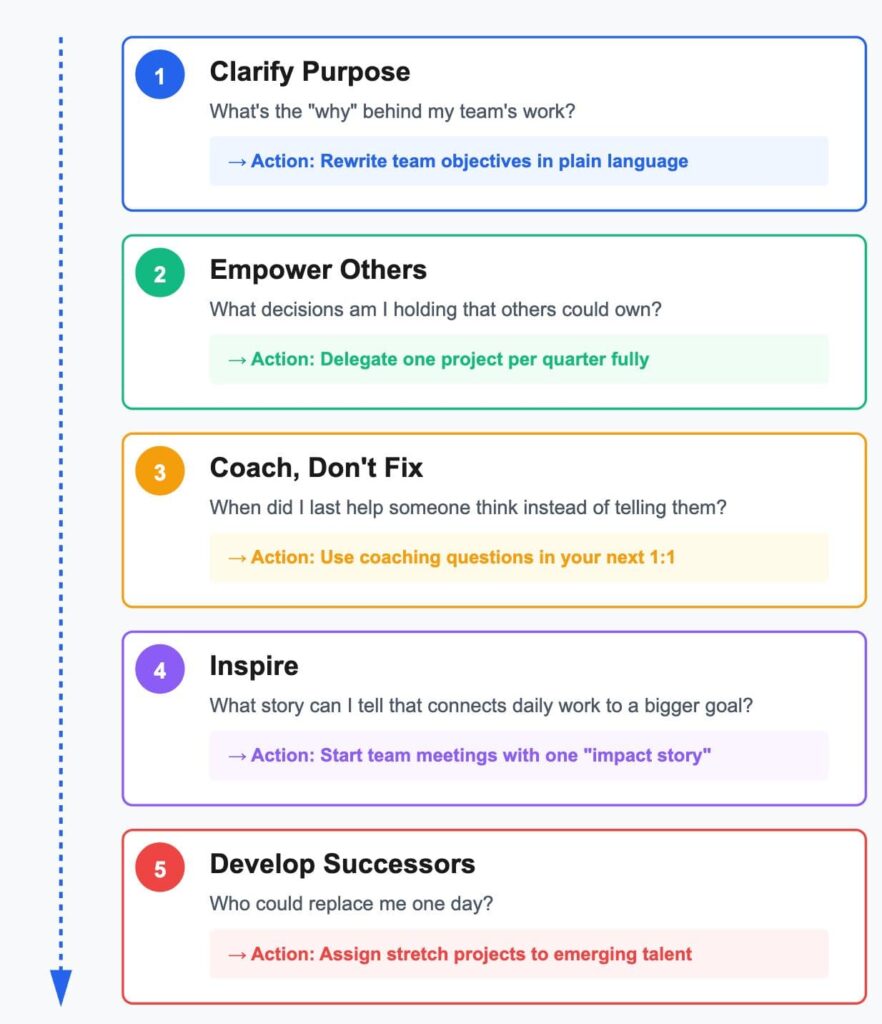
Clarify Purpose
- What’s the “why” behind my team’s work?
- Action: Rewrite team objectives in plain language
Empower Others
- What decisions am I holding that others could own?
- Action: Delegate one project per quarter fully
Coach, Don’t Fix
- When did I last help someone think instead of telling them?
- Action: Use coaching questions in your next 1:1
Inspire
- What story can I tell that connects daily work to a bigger goal?
- Action: Start team meetings with one “impact story”
Develop Successors
- Who could replace me one day?
- Action: Assign stretch projects to emerging talent
Download my Manager Duty template
Get a summary of your key managerial duties (the non-negotiables) to clarify your role as a manager. A good way to use this document is to review it with your management and/or HR team to confirm and align your core responsibilities.
The Real Test: Have You Mastered the Difference?
You’ll know you’ve moved from manager to leader when:
- Your team takes initiative without you
- People quote your vision when you’re not around
- You have more impact through others than by yourself
That’s when management turns into leadership.
Bottom Line on the Difference Between Managers and Leadership
The difference between manager and leader isn’t just semantics. It’s a mirror for how we run organizations.
Managers keep the lights on. Leaders show us where to go next.
You can’t inspire without delivering, and you can’t deliver without inspiring. So don’t choose one over the other. Choose to master both because your team deserves someone who can get things done and make them want to do it.
But remember: start with management. Build the foundation. Master the 6 core skills. Then add leadership on top of that solid base. If you’re still building your foundation as a manager, read my guide for new managers. It covers the practical skills that turn good intentions into consistent results.
Because nobody follows someone who can’t execute. And nobody stays with someone who can’t inspire.
MORE MANAGER DEVELOPMENT RESOURCES
This article is part of our manager development resources.
Stay sharp for Monday
Practical resources to help managers lead smarter, faster, and with confidence.

Free manager resources for new Managers
View Article
The 30-60-90 Day Plan for New Managers: From Setup to Results
View Article