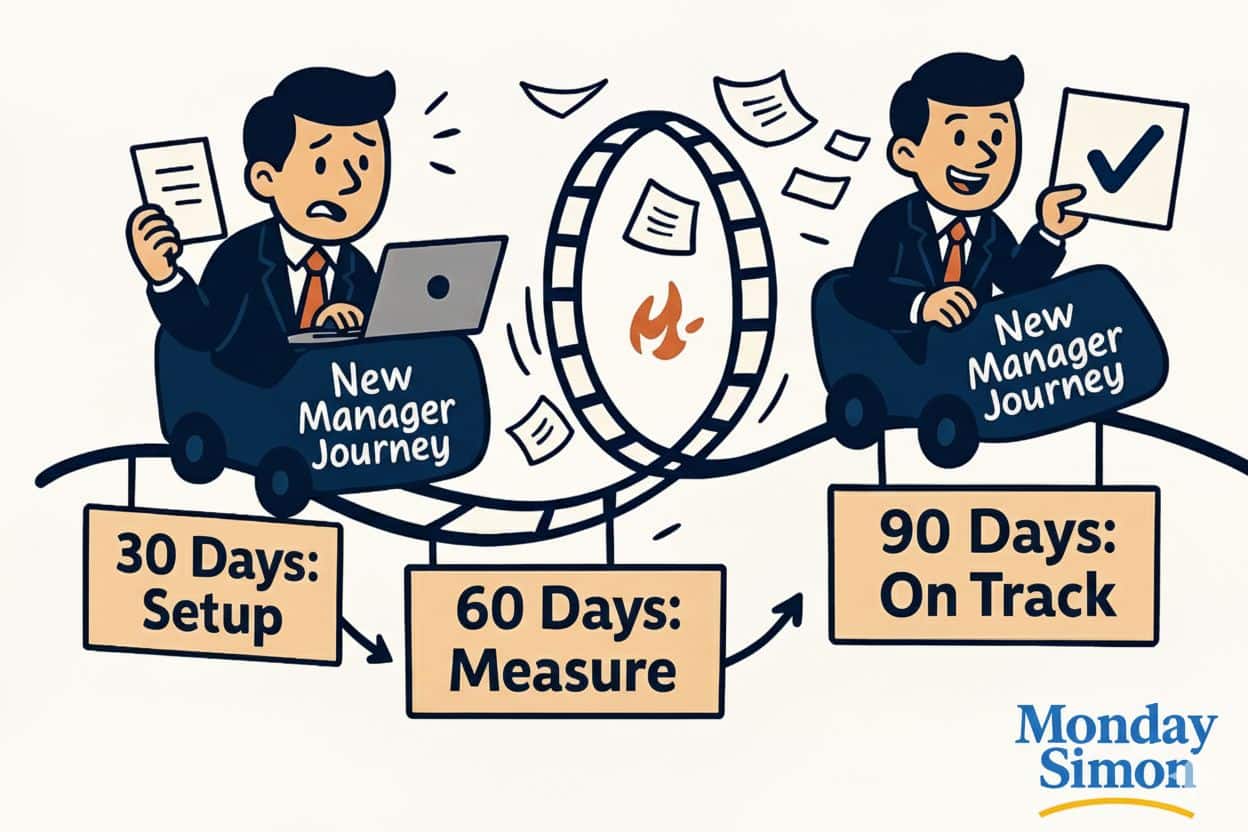
Key takeaways
- Treat the First 30 Days as a Diagnosis: Use your 1-on-1s as data-gathering tools, not just “get to know you” sessions. Ask what is blocking the work and hunt for patterns in the frustrations you hear. Your goal is to understand the “real” org chart and performance gaps before you spend energy fixing things that don’t matter.
- Validate Objectives Before You Rally the Team: Ruthlessly prioritize 3–5 SMART goals based on your initial findings, then get your boss’s sign-off in writing. Nothing kills a new manager’s credibility faster than getting the team excited about a direction that leadership doesn’t actually support.
- Secure a “Real” Win by Day 60: Move past simple, quick fixes and lead your team through a project that requires coordination and has a visible impact. The objective here is to prove you can identify a problem and coordinate a solution without slipping back into “Hero Manager” mode by doing it all yourself.
- Execute with High-Visibility Metrics: By Day 90, you should have 3–5 key metrics that you track and share weekly. Use this data to create shared awareness, not to shame people. If the numbers show you’re off-track, be the manager who transparently adjusts the tactics or targets instead of just hoping for the best.
- Tether Feedback to Shared Goals: Connect every performance conversation directly to the team’s objectives. When you use the FIAC method (Fact, Impact, Ask, Continue) to link an individual’s work to the team’s success, feedback feels like fair coaching rather than a personal attack.
Table of Contents
You Have the New Manager Checklist. Now Execute It.
You worked through your new manager checklist. You set up your one-on-one. You clarified expectations with your boss. You established your weekly rhythm. You documented your decision boundaries.
Good. That was the foundation. Now comes the harder part: actually using these systems to deliver results.
Your first 90 days are not just about setting things up. They are about proving you can translate setup into performance. It is easy to understand the theory, but of course harder to nail the execution.
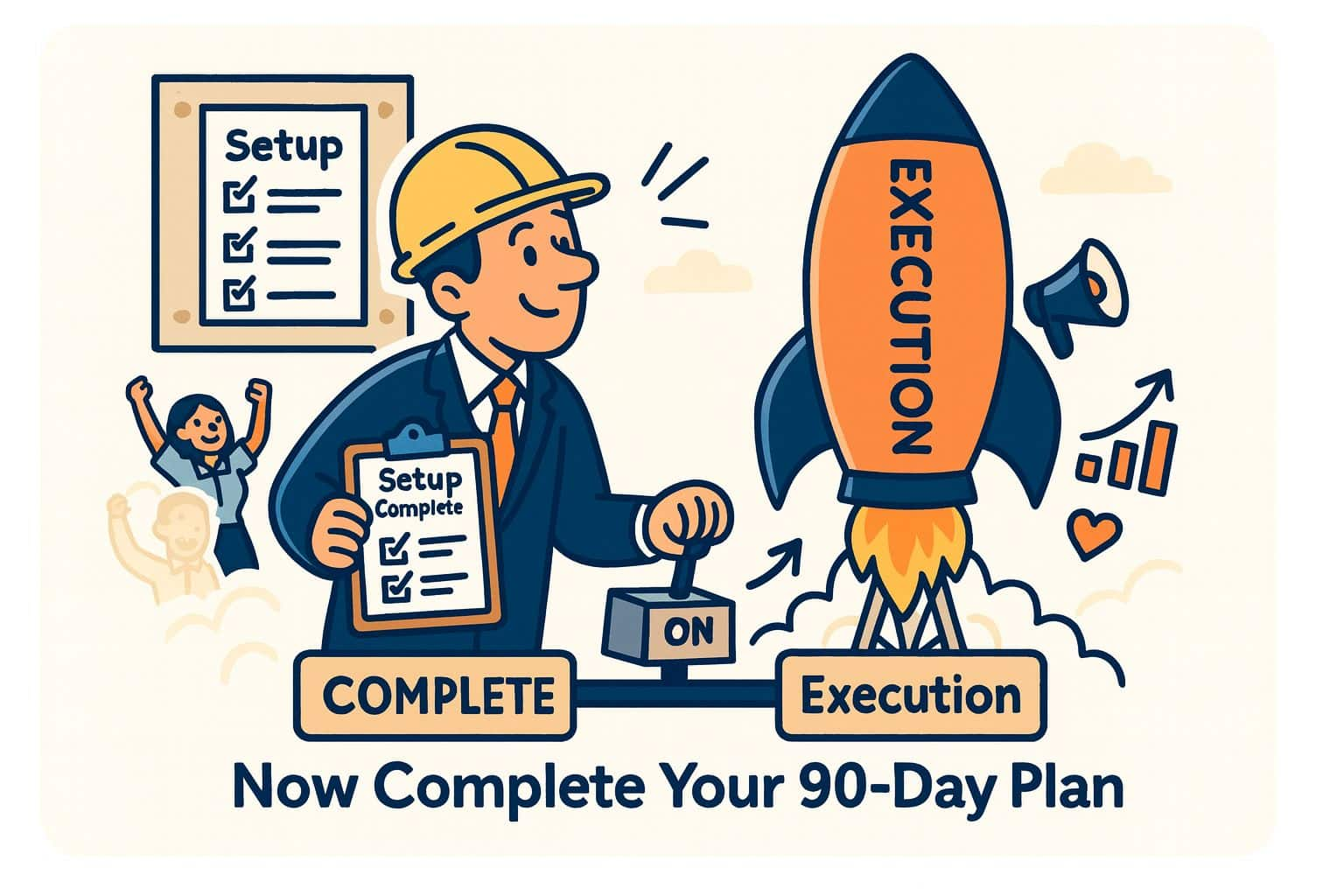
This is where your 30 60 90 day plan for new managers comes in. Not as another checklist. More as your execution roadmap to show you what to prioritize each month and how to progressively build from “observation” to “action”.
Why the 30 60 90 Plan Structure Actually Works
The 30-60-90 plan for a new manager is not arbitrary. It matches how organizations actually operate and how credibility gets built in the real world. As mentioned earlier, every organization is unique. Keep in mind that some organizations will not give you this amount of time, so ensure this can be adjusted according to your own organization’s culture.
Days 1-30: You are in observation mode. You have systems running but you are using them to gather data, not drive change (yet). Your job is to understand reality (and the expectations) before you try to reshape it with your own touch.
Days 31-60: You shift from observer to operator. You take what you learned and translate it into clear team objectives for your team. You align these objectives with your boss and you start executing on priorities.
Days 61-90: You move into performance mode. You are tracking results, giving performance feedback, making adjustments, and proving you can lead a team to outcomes.
Each phase builds on the previous one. Rush through phases and you make decisions without context.
Days 1-30: Use Your Systems to Understand Reality
Phase objective: Gather quality data about your team, stakeholders, and constraints before making commitments.
The one on ones you are setting up with the teams are not just relationship-building sessions. They are your primary data collection tool for understanding what is actually happening versus what people say is happening.
Week One: The Diagnostic Conversations
Your first one-on-ones should focus on three questions, but listen for what is not being said:
“What is going well right now?” tells you what people value and want to protect.
“What is frustrating or blocking you?” reveals the real problems, not the official ones.
“Where would you need my support?” shows you who thinks strategically and who just wants their immediate pain solved.
Take detailed notes. Look for patterns. When three people mention the same broken process, that is a signal. When someone says everything is fine but their body language says otherwise, that is a signal too.
You already clarified expectations with your boss using the checklist. Now use your weekly check-ins to pressure-test what you are learning. Script: “I am hearing from the team that X is a major blocker. Does that align with what you see as the priority to fix?”
Important note during the first month: When the team is up and running, the pace for one on ones can be monthly. When you first join a team, it is key to spend dedicated time with your team members, I strongly recommend weekly one on one ones. Contrary to common recommendations, a one on one does not have to be a full hour, if they are organized, at least 20 min.
Scheduling diagnosis conversations prevents you from spending 30 days solving problems your boss does not care about, or does not even know about.
Week Two to Four: Pattern Recognition
By week two, you should start seeing patterns in your data:
- Which processes waste the most time?
- Where do handoffs break down?
- Who are the informal leaders people actually listen to?
- What initiatives failed before and why?
Use your team meetings (already scheduled from the checklist) to validate what you are seeing. Float observations without announcing solutions: “I am noticing that report X takes about five hours weekly. Is that adding value or is it legacy bureaucracy?”
People will tell you the truth when you ask without judgment.
Your stakeholder map from the checklist now becomes active. Meet with each key stakeholder for 30 minutes. Ask: “What does good look like from my team’s perspective? Where have we fallen short? What should I absolutely not change?”
These conversations prevent you from fixing things that other departments depend on, even if your team hates them.
What You Should Know by Day 30
By the end of month one, you should have clear answers to:
Performance baseline:
- What is our current performance against existing KPIs and OKRs?
- Where are the gaps between targets and reality?
- What is causing the gaps skill, process, resources, or motivation?
Team capability:
- Who are the high performers I can rely on?
- Who is struggling and why?
- Who has untapped potential?
- Who is at flight risk?
Political landscape:
- Who has informal power and influence?
- What are the sacred cows I should not touch?
- Where is there appetite for change and where is there resistance?
Resource constraints:
- What budget, tools, or authority do I actually have?
- What needs approval and from whom?
- What can I change alone versus what needs buy-in?
If you cannot answer these questions by day 30, you are not ready for day 31.
Days 31-60: Translate Data Into Aligned Objectives
Phase objective: Convert what you learned into clear team goals that your boss validates and your team owns.
Month two is where most new managers either prove they can prioritize or expose that they cannot. You have 30 days of data. Now you need to turn it into a focused plan.
Setting Team Objectives That Drive Performance
Goals need to be SMART, period. The skill here is not only writing SMART goals, but it is choosing the RIGHT goals based on what you learned in month one.
Start by listing every problem you identified. Then ruthlessly prioritize:
- What has the biggest business impact if we fix it?
- What is achievable in the next quarter?
- What aligns with my boss’s top three priorities?
You should land on three to five team objectives maximum. Not ten. Not twenty. Three to five.
Bad objectives sound generic: “Improve customer satisfaction.” “Increase team productivity.” These do not drive behavior because nobody knows what to actually do.
Good objectives are specific and time-bound: “Reduce average customer response time from 72 hours to 24 hours by end of Q2.” “Decrease error rate in monthly reporting from 8% to under 3% by June 30.”
Again, you do not need to make a revolution. It is good news that everything before was running smoothly, but this is rarely the case. If “everything” is good already, then focus on process improvement to look at quick wins you can get.
The Critical Validation Step
Here is where most managers screw up: they set goals and announce them without validating with their boss first. OR they jump in, meet the team, promise improvements that never get accepted. I always repeat this, but do not burn yourself.
Instead, draft your proposed objectives. Schedule time with your boss. Present them: “Based on my first 30 days, here are the top priorities I see for the team. I focused on these three because they align with our objective to improve delivery speed and reduce rework. I want to ensure these objectives are matching our strategic direction for the year. What are your thoughts on this?”
Most bosses will appreciate you asking. Some will redirect you. Either way, you avoid the disaster of rallying your team around goals your boss never cared about.
Once validated, bring the goals to your team. But do not just announce them. Involve them in the “how.”
Present: “Based on my conversations with leadership and my first month observations, here are our top three priorities for the quarter. I want your input on how we achieve these and what obstacles we need to plan for.”
This creates buy-in. When people contribute to the execution plan, they own it.
Selecting Your First Real Win
Your checklist already helped you identify a quick win in month one (killing a useless report, fixing an obvious process issue). That bought you initial credibility.
Now you need a real win. Not a quick fix. A meaningful improvement that proves you can lead a team to deliver results.
Look for something that:
- Ties directly to one of your team objectives
- Requires coordination across multiple people
- Can be completed within 30 to 45 days
- Has visible impact that stakeholders will notice
Example: If your objective is reducing response time, your first win might be implementing a triage system that routes urgent requests to available team members instead of a broken queue system.
The objective is to prove you can identify a problem, design a solution, coordinate execution, and deliver an outcome (not do it yourself as the “Hero” manager would do).
MORE MANAGER DEVELOPMENT RESOURCES
This article is part of our manager development resources.
Clarifying Ownership and Accountability
You used your checklist to clarify roles generally. Now you need to assign specific ownership for each objective.
Create a simple ownership matrix:
- Objective 1: Reduce response time > Owner: Sarah (with support from tech team)
- Objective 2: Decrease error rate > Owner: Michael (with quality review from Anna)
- Objective 3: Launch new onboarding process > Owner: You (with input from HR)
Make it public. Review it in team meetings. When everyone knows who owns what, accountability follows.
What You Should Deliver by Day 60
Documented team objectives:
- Three to five SMART goals for the quarter WITH a SMART action plan for each
- Boss validation confirmed in writing
- Team alignment on goals and execution approach
First real win in progress:
- Clear project with owner, timeline, and success criteria
- Weekly progress tracking in team meetings
- Visible momentum that stakeholders can see
Ownership clarity:
- Every major objective has a clear owner
- Team members understand their accountability
- Escalation paths defined for obstacles
If you hit day 60 without validated goals and a win in motion, you have wasted month two.
Days 61-90: Execute, Measure, and Adjust Performance
Phase objective: Prove you can manage performance by tracking results, giving feedback, and adjusting based on data.
Month three is where you move from planning to performing. This is when you start acting like an actual manager instead of someone setting up to be a manager.
Implementing Performance Tracking
You have objectives from month two. Now you need to track whether you are hitting them.
Pick three to five metrics that directly measure progress on your objectives (my strong recommendation is to keep with 3):
- If your objective is reducing response time, track: average hours to first response, percentage of responses under 24 hours, backlog size
- If your objective is reducing errors, track: error rate per report, percentage of reports requiring rework, time spent on corrections
Make these metrics visible. Share them weekly in team meetings. Not to shame people. To create shared awareness of whether you are on track or falling behind.
When metrics show you are off track, discuss why and what needs to adjust. When metrics show improvement, acknowledge it publicly.
Giving Performance Feedback That Drives Results
The frequency of your feedback also dictates your capacity to improve performance and grow the team.
Use your one-on-ones to connect individual performance to team objectives. Example: “We are trying to hit 24-hour response time as a team objective. Last month your average was 38 hours. Walk me through what is causing the delay and what support you need to get closer to target.”
This is not criticism. This is performance coaching.
When someone is performing well, be specific about what they are doing right and why it matters: “Your response time averaged 18 hours last week, which helped us hit our team target. The way you triaged urgent requests and handled them first is exactly the behavior we need. Keep it up.”
When performance is below standard, use FIAC Feedback (from your checklist) but connect it to the team objective: “Your last three reports had errors that required rework (Fact). This delayed our monthly close by two days and put us at risk of missing our error reduction target (Impact). What is happening? (Ask). Let’s set up a peer review process before submission (Continue).”
Feedback without connection to objectives feels arbitrary. Feedback tied to shared goals feels fair.
Running Your First Performance Check-In
By day 75, you should run a formal mid-quarter performance check-in with each team member. This is different from your regular one-on-ones. This is about evaluating progress against the objectives you set in month two.
Structure:
- Review their contribution to team objectives (with data)
- Assess their individual performance (what is working, what needs improvement)
- Discuss development needs or obstacles
- Confirm commitments for the final two weeks of the quarter
Document this conversation. This becomes the foundation for your first real performance review.
Adjusting Based on Reality
By day 80, you will know whether your month two objectives are realistic or need adjustment. If you are tracking to hit targets, great. Keep executing.
If you are falling short, you have two choices:
- Adjust tactics (change how you are pursuing the objective)
- Adjust targets (revise the objective based on new information)
Either is fine, but you need to be transparent with your boss and team. “We set a target of 24-hour response time. We are averaging 32 hours. I am adjusting our approach by implementing a triage system. If that does not close the gap by end of month, I will revise the target to 28 hours and extend the timeline.”
This is not failure. This is managing performance based on reality.
Presenting Your Forward-Looking Plan
By day 90, you should present a six-month roadmap to your boss. Not a detailed project plan. A one-page overview that shows you can think beyond this quarter.
Include:
- Top three priorities for the next two quarters
- Key initiatives or projects to support those priorities
- Known risks and how you plan to mitigate them
- Resource needs (budget, headcount, tools)
This shows you are not just executing tasks. You are thinking strategically about where the team needs to go.
Share a simplified version with your team so they understand the direction and how their current work connects to future goals.
What You Should Achieve by Day 90
Performance system running:
- Three to five KPIs tracked weekly
- Monthly feedback delivered to every team member
- First formal performance check-ins completed with data
First real win delivered:
- Meaningful improvement tied to team objective completed
- Results communicated to stakeholders
- Team credit shared appropriately
Forward plan established:
- Six-month roadmap presented to boss and shared with team
- Clear priorities for next quarter defined
- Team understands where they are heading
If you reach day 90 without a functioning performance system and delivered results, you failed month three.
Common Failure Modes in the First 90 Days
Treating each month the same. Month one is about observation. Month two is about alignment. Month three is about performance. If you skip ahead or stay stuck in one mode, you fail.
Setting goals without boss validation. You spend 60 days working on priorities your boss does not care about. Your first review is a disaster.
Announcing goals without team input. You get compliance but not commitment. People execute but do not own the outcome.
Tracking too many metrics. Nothing gets focus. Performance conversations become overwhelming.
Avoiding performance feedback. Problems compound. By day 90, you have performance issues that should have been addressed in day 45.
Not adjusting when reality changes. You stick to unrealistic targets instead of adapting based on data.
Your 30-60-90 Manager Checklist
Download your 30-60-90 day manager checklist below:
Days 1-30: Data Collection Phase
What you are doing:
- Using one-on-ones to diagnose team capability and problems
- Validating observations with boss in weekly check-ins
- Building stakeholder relationships through 30-minute meetings
- Identifying patterns in performance, process, and politics
What you must know by day 30:
- Current performance baseline against existing KPIs
- Team capability map (high performers, struggles, potential, flight risks)
- Political landscape (informal power, sacred cows, change appetite)
- Resource constraints (budget, authority, approval requirements)
Days 31-60: Goal Alignment Phase
What you are doing:
- Converting month one data into three to five team objectives
- Validating objectives with boss before announcing to team
- Involving team in execution planning for buy-in
- Selecting and launching first real improvement project
- Assigning clear ownership for each objective
What you must deliver by day 60:
- Documented team objectives (SMART, boss-validated, team-aligned)
- First real win in progress (clear owner, timeline, tracking)
- Ownership clarity (everyone knows their accountability)
Days 61-90: Performance Execution Phase
What you are doing:
- Tracking three to five KPIs tied to team objectives weekly
- Giving monthly performance feedback connected to objectives
- Running first formal performance check-ins with each team member
- Adjusting tactics or targets based on actual results
- Presenting six-month roadmap to boss
What you must achieve by day 90:
- Performance tracking system operational
- Monthly feedback delivered to all team members
- First real win completed and communicated
- Forward plan established and shared
The Difference Between Setup and Execution
The checklist is about systems. The plan is about using those systems to drive outcomes.
Most managers confuse having the system with using the system. They set up one-on-ones but do not extract insights from them. They establish feedback rhythms but do not connect feedback to performance. They create team goals but do not track progress or adjust.
Do not be most managers.
By day 90, you should not just have management infrastructure. You should have results you can point to, a team that trusts your direction, and a boss who sees you can deliver.
If you’re still figuring out how to move from setup to execution, read the Ultimate Guide for New Managers. It walks you through goal setting, feedback, and performance systems that actually work.
That is what separates managers who survive from managers who thrive.
Become a manager
You’ve got the plan. Now you need the skills to execute it.
The 30-60-90 plan sets up your infrastructure. But the real work starts when you need to master the five core manager skills that separate setup from results.
Explore my manager development program
5 Complete Modules: Introduction to People Management, Goal Setting, Competency Development, Coaching & 1-on-1s, Performance Management in Practice.
Stay sharp for Monday
Practical resources to help managers lead smarter, faster, and with confidence.

What Is Performance Management? A Practical Guide for Managers
View Article
How to Use SMART Goals to Increase Productivity
View Article