
Key takeaways
- Kill Ambiguity with Precision: Don’t just “improve” things; define the exact scope. A SMART Goal starts by eliminating guesswork, shifting from a vague “fix the website” to a precise “reduce mobile checkout latency.” If your team has to ask what “success” looks like, you haven’t been specific enough.
- Lock in Verifiable Metrics: If you can’t measure it with a number, rate, or percentage, it’s a wish, not a goal. Use measurable targets to turn performance reviews into a simple objective “yes or no” check instead of a subjective argument about “how hard” someone worked.
- Audit Reality and Deadlines: Before assigning a goal, verify your team actually has the tools, budget, and authority to hit it. Set a non-negotiable “by when” date to stop projects from being endlessly deferred and to force your team to prioritize what actually moves the needle.
Table of Contents
How to set SMART goals is part of Monday Simon Manager Development Program:
👉 Module 2: Goal setting for managers
👉 Module 5: Performance management in practice

Your team needs to know exactly what winning looks like. You need a system that defines accountability upfront. You set this system by setting SMART Goals.
What are SMART Goals
SMART Goals are a simple, five-point checklist used to ensure that every target you set is clear, measurable, and achievable. It takes your vague intentions and turns them into a detailed, executable plan. It’s the framework that eliminates the question, “Did we actually hit the target?” and replaces it with a simple yes or no.
This is a smart goal:
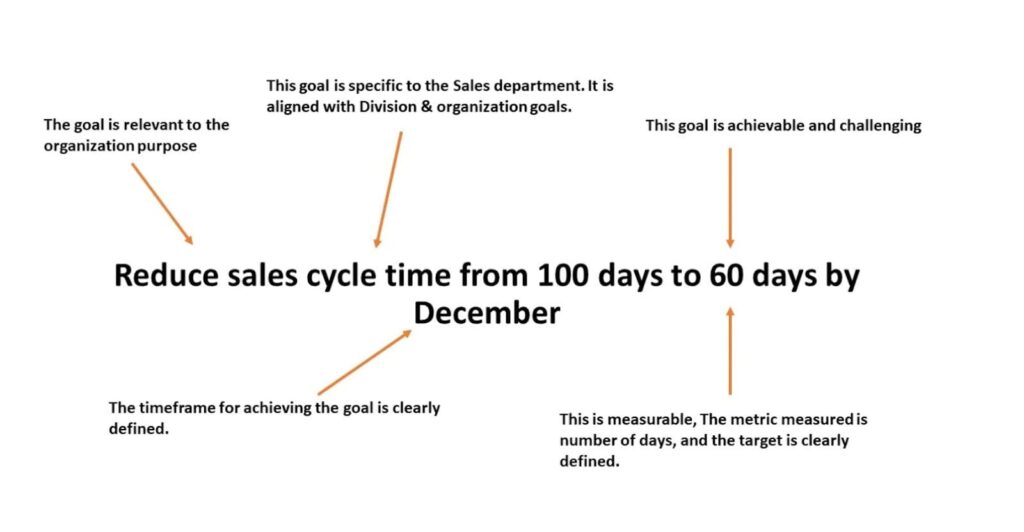
When done right, using SMART Goals is the difference between hoping for results and demanding them.
When to Use SMART Goals
While using this for almost everything, the SMART Goals framework is absolutely mandatory in these high-stakes situations:
- Performance Reviews: When setting the official targets against which an employee’s bonus or rating will be judged. Goals are part of your performance management process. Their achievement helps you identify who your high performers, poor performers, and high potential employees.
- Project Initiation: When kicking off a new, complex project, where success metrics are not immediately obvious.
- Performance Improvement Plans (PIPs): When defining the specific, non-negotiable standards required for an underperformer to keep their job.
Note : The relevance of your SMART goals MUST be reviewed periodically and assessed with your subordinates during one on one meetings.
The Practical Manager’s Guide to Using SMART Goals
The power of SMART Goals does not lie in the fancy acronym.
- S – Specific: Be precise. Instead of “Improve the website,” define it as “Reduce the latency time on the checkout page for mobile users.” A SMART Goal starts by eliminating all ambiguity about the scope of work.
- M – Measurable: How will you prove you hit it? This must be a number, rate, or percentage. Reduce latency time from 3.5 seconds to 1.5 seconds. If you can’t measure it objectively, it’s not a goal (or at least not a smart goal).
- A – Achievable (or Actionable): The goal must be something the employee/team has the resources and authority to actually deliver. Your VP might want 100% market share, but that’s not Achievable for your team. A true SMART Goal must be ambitious yet grounded in reality.
- R – Relevant: Does this goal matter to the business right now? If your team is focused on cost-cutting, a goal to launch a costly new social media campaign might be Achievable, but it’s not Relevant to the current organizational priority. Connect it to a core KPI or OKR. Learn more about KPIs and OKRs.
- T – Time-Bound: When is the absolute, non-negotiable deadline? Deliver the latency reduction by the end of Q3 (September 30th). Without a date, the goal is just an intention that can be endlessly deferred.
This structured thinking, particularly the focus on Measurable and Time-Bound, put a stop to arguing about effort and started tracking results. The failure of most goal-setting is the failure to properly define the SMART Goals upfront.
As always, it is easier said than done. To quickly revise your objectives and transform them into SMART goals, you can use my ChatGPT for SMART goals.
Why SMART Goals are Critical to Your Success
SMART outcomes drive outcomes efficiently, not chasing an ambiguous dream.
- Eliminates Ambiguity: Your team knows exactly where to focus their limited time and effort, cutting out non-essential work and driving velocity.
- Forces Resource Allocation: By determining the Achievable aspect of the goal, you are forced to confront whether the employee actually has the tools, budget, or authority to succeed before they fail.
- Makes Performance Reviews Objective: Since the goal is Specific and Measurable, you don’t argue with an employee about if they succeeded; you simply check the metric.
SMART objectives are easy to understand, but they are rarely put into practice by managers. If you need additional resources and templates to manage your team members, you can check my Manager tools page.
MORE MANAGER DEVELOPMENT RESOURCES
This article is part of our performance management resources.
Stay sharp for Monday
Practical resources to help managers lead smarter, faster, and with confidence.

What Is Performance Management? A Practical Guide for Managers
View Article
How to Master KPIs and OKRs for Team Management
View Article