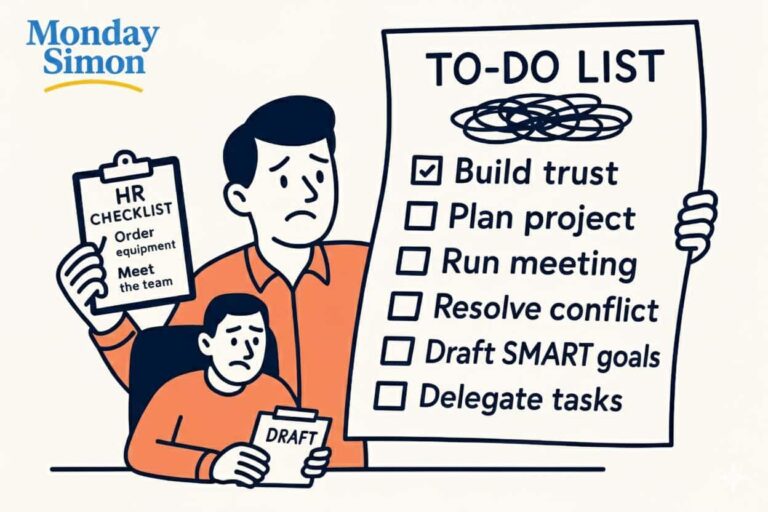
Key takeaways
- Negotiate the Scorecard, Not Just the Title: Before you celebrate the promotion, get crystal clear on whether you are truly a manager or just a “player-coach.” Get your actual authority levels for hiring, firing, and budget control in writing. If success metrics are vague, you’re stepping into a trap, not a role.
- Kill Your Old Job to Save the New One: Don’t fall into the trap of doing two jobs for one salary. Negotiate a hard stop date for your individual contributor tasks and a clear backfill plan. If you don’t plan your exit from your old “doing” work, you’ll never have the headspace to actually start “enabling” your team.
- Map the Political Landmines Early: Management is played across the organization, not just down. Before your start date, identify who actually has your boss’s ear and which stakeholders can block your initiatives. These “coffee chats” aren’t just social; they are intelligence-gathering missions to find where the bodies are buried.
- Pack Your Management Toolkit Before Monday Morning: Don’t waste your first month inventing spreadsheets. Have your 1:1 templates, feedback frameworks, and “Working with Me” philosophy ready before Day 1. Showing up with a system proves you’re a pro and prevents you from being reactive from the jump.
- Set Your Boundaries Before You Burn Out: If you start answering emails at 11 PM in week one, that becomes the team’s expectation forever. Establish your non-negotiables, like protected 1:1 time and after-hours availability. It’s much easier to hold a line from the start than to try to move it six months later.
Table of Contents
The Problem: Most New Managers Walk in Blind
Most new managers show up on Day 1 with zero preparation. It’s like trying to build a plane while flying it. Difficult in these conditions not to end up in a crash.
The work you do BEFORE you officially start determines whether you succeed or fail in your first 90 days. Yet nobody talks about this critical preparation phase. They just hand you the title and expect magic to happen.
Most new manager tips fall into two useless categories:
Category 1: Motivational Fluff “Inspire your team.” “Create a vision.” “Be authentic.” Translation: We have no actual advice, so here are some nice-sounding words.
Category 2: Academic Theory “Implement systematic feedback mechanisms.” “Leverage emotional intelligence frameworks.” Translation: This sounds smart, but you can’t use it on Monday morning.
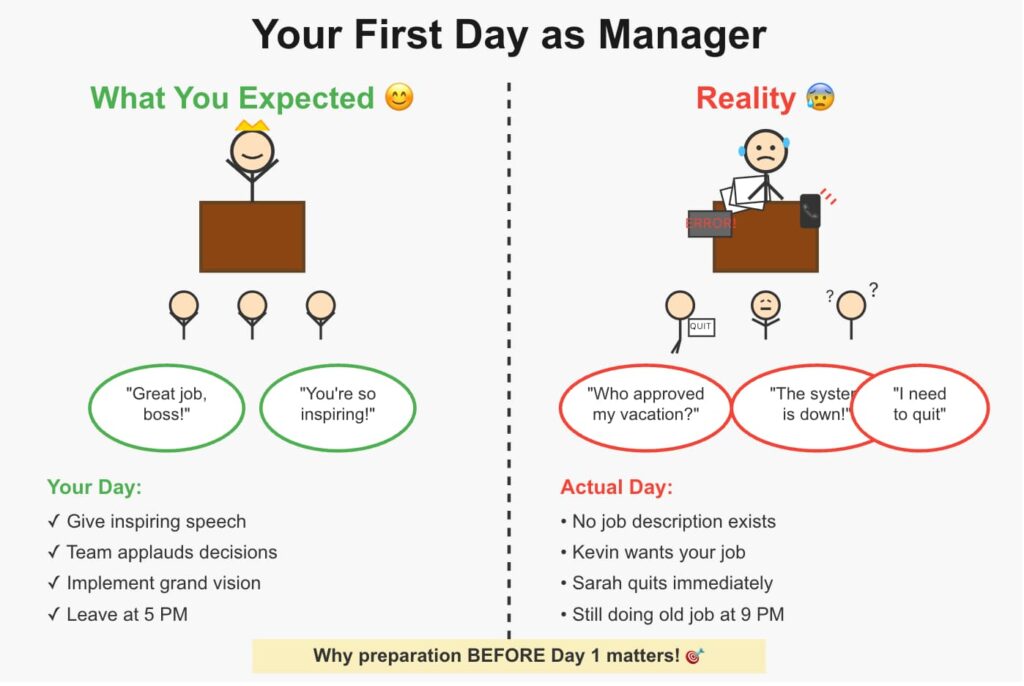
Let’s walk through some new manager tips that could be practical enough to implement before you step into a new job.
New Manager Tip #1: Lock Down What Success Looks Like Before Day 1
Before you accept that promotion or even celebrate it, you need clarity on what success looks like in this role.
The Critical Question: Are You Still an Individual Contributor or Actually a Manager?
This isn’t as obvious as it sounds. Many organizations promote people to “manager” but still expect significant individual output. You get the title and the headaches, but not the actual role transition. Some companies want a “player-coach” which really means “do your old job plus manage people in your spare time.”
I exaggerate just a bit. When you are in a small team, you still need to deliver individual outputs, but you get my point.
I recommend scheduling a pre-start meeting with your boss and getting specific answers. Accept the role until you understand:
- What percentage of your time should go to managerial work versus hands-on work
- Which technical tasks are you still expected to deliver personally
- How will your performance be evaluated: on your individual output or your team’s results?
- What your compensation and incentives are actually tied to the team performance vs your individual performance.
If your boss gives you vague answers like “we’ll figure it out as we go,” that’s a red flag the size of Texas. Push for specifics. Write down what you hear. Send a follow-up email summarizing the conversation. Get confirmation in writing.
When It’s Truly a Managerial Role: Understanding the New Scorecard
If your role is genuinely managerial, your entire success framework changes. You’re no longer measured on how many tasks you personally complete. Your new metrics revolve around:
- Team productivity and collective outcomes
- Quality of team deliverables and work products
- Retention, engagement, and morale of direct reports
- Development and growth of team members
- Process improvements and efficiency gains
- Cross-functional collaboration and influence
Stop thinking about your personal to-do list. Start thinking about your team’s capacity and output. This mental shift is harder than it sounds, especially if you’ve been a high performer. You need to rewire your brain before you start, not after. I have highlighted the common pitfalls of new managers in Part 1 of my manager development program.
New Manager Tip #2: Get Everything in Writing Before You Accept
In reality, we get excited about the promotion, because we want that raise badly. The downside to rushing the offer is to operate in ambiguity because you were too polite to ask hard questions up front.
Get the Real Job Description
Ask HR or your boss for the official job description. When they send you a generic template from 2015 that could apply to any manager in any company, push back. That’s not what you need.
What you actually need clarified and documented:
- The specific humans who will report to you, by name and role
- Your key deliverables and measurable accountabilities
- Your actual authority levels for hiring, firing, budgets, and process changes
- Which decisions can you make autonomously, versus what needs approval
- What resources are allocated to you, including budget, headcount, and systems
Here’s what usually happens: The written job description says one thing, your boss promises something different, and HR has a third interpretation. Surface these gaps now while you still have negotiating power, not three months in when you need to terminate someone and discover you don’t actually have that authority.
Never accept a verbal promise about responsibilities or authority. If it’s not in writing, it doesn’t exist, that’s my point of view.
You can feel free to amend or to suggest the job description yourself.
Here is my custom GPT for job descriptions.
Navigate the Grey Areas
During your pre-start discussions, probe every ambiguous area until it’s crystal clear. Ask uncomfortable questions like:
- Can I actually hire, promote, or terminate someone?
- What’s my real spending authority versus what needs three levels of approval?
- Who are the sacred cows I can’t touch, even if they’re underperforming?
- What promises were made to the team that I’m inheriting?
- What political landmines exist that nobody will officially acknowledge?
Document every answer. If you find discrepancies between what’s promised and what’s written, politely suggest amendments now or at least get operating procedures clarified in email.
Lock Down Your Compensation Structure
A managerial role usually comes with new compensation structures. Understand:
- Base salary adjustment and timing
- Bonus or incentive structure and targets
- How much is tied to team versus company performance
- Non-monetary perks like training budgets or conference attendance
- Next review cycle and promotion timeline
Knowing the details above is to know the conditions of the next promotions. Basically is to have the keys to success before you even start.
New Manager Tip #3: Map Your Political Landscape Before You’re in It
Management isn’t just about managing down. It’s about navigating complex relationships across the organization. Smart managers map this terrain before they start, not after they’ve already stepped on landmines.
Identify the Real Power Structure
Org charts show reporting lines. They don’t show who actually makes decisions, who influences those decisions, and who can help or hurt you. Before you start, figure out:
- Who has your boss’s ear?
- Which peer managers are rising stars versus those on their way out?
- Who controls resources you’ll need?
- Which stakeholders can block your initiatives?
- Who are the informal influencers that everyone listens to?
Request meetings with adjacent managers and functional leads before your start date. Position these as informal coffee chats to “better understand how to support their teams.” What you’re really doing is intelligence gathering.
Note: There’s always someone in the company who won’t cooperate with you, whether it’s personal, political, or just how they operate. Depending on their influence, you need to identify these people before you start, not after they’ve sabotaged your first initiative.
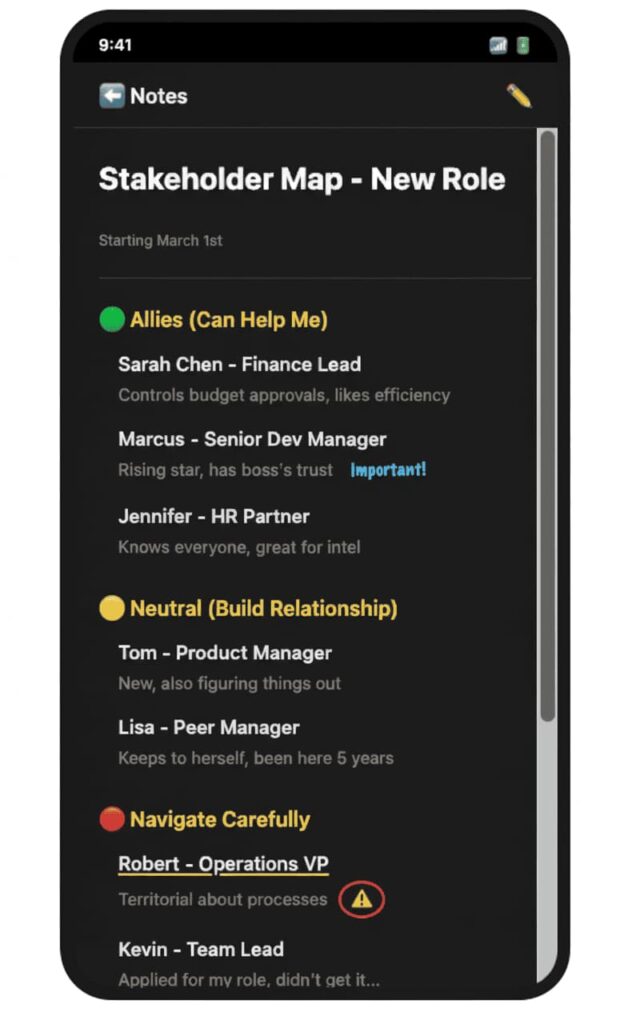
Learn What You’re Really Walking Into
Schedule time with your predecessor if possible. Or at least get some information about:
- Why the predecessor left (the resignation letter was probably BS)
- Which team members are flight risks
- What were some positive initiatives to keep VS what could have been improved
- What promises were made but not kept
It’s important for you to know where the bodies are buried. New roles mean unclear expectations and no established success patterns. Predecessor silence usually means they left on bad terms.
New Manager Tip #4: Audit Your Future Team Before You Inherit Them
If you are promoted from within, meeting the future team should be easy. An easy step that helps you gain clarity on the team’s dynamics before you start. If you are interviewed from the outside, I recommend you request a short team meeting.
Gather Performance Intelligence with the new team:
- Review any available performance data or team metrics
- Check the team’s turnover history for the past two years
- Understand current project statuses and commitments
- Identify who’s been passed over for promotion
- Learn who applied for your role and didn’t get it
This isn’t about prejudging people. It’s about understanding what situation you’re walking into so you can prepare appropriately. If half your team has one foot out the door, you need a retention strategy before you start (not after they’ve given notice).
HR won’t tell you who’s about to quit or who’s impossible to work with. Former managers will, especially over drinks. Use your network.
Understand Team Dynamics and History
Every team has unwritten rules, informal hierarchies, and historical baggage. Before you start changing things, understand:
- Who are the informal leaders the team actually listens to?
- What recent changes or traumas has the team experienced?
- Which team members have conflicts with each other?
- What promises were made by previous management?
- What’s the team’s reputation in the broader organization?
If you’re inheriting a “problem team,” you need to know that before your first day not discover it in your first month.
New Manager Tip #5: Negotiate Your Transition Before You’re Stuck
Companies are great at promoting you but terrible at transition planning. They expect you to instantly become a manager while still delivering your individual contributor work. Make this a priority.
Create a Real Transition Plan
Before accepting the role, negotiate:
- How long you’ll still handle old responsibilities (with a hard stop date)
- Who specifically takes over your current work
- What happens to your in-flight projects
- How your replacement gets trained
- What backfill support you’ll receive
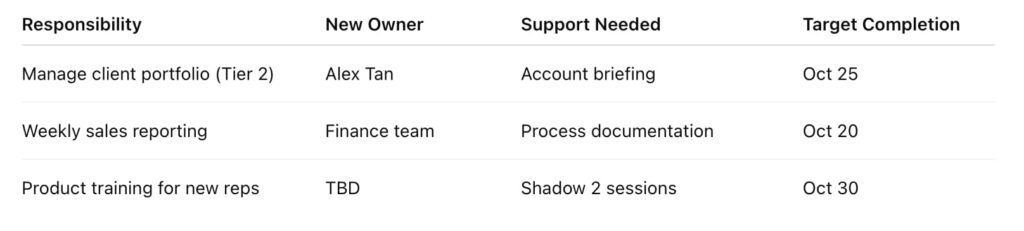
If they say “we’ll figure it out,” that means you’ll be doing two jobs for the price of one. If you have been reading my content, you know I am particularly prone to “get it done yourself”. If the company has not done a transition plan, you can also pre-draft it to create the conditions of your own success.
New Manager Tip #6: Build Your Management Toolkit Before You Need It
The risk as a new manager is to spend the first month understanding the management frameworks and/ or creating basic frameworks instead of actually managing.
Prepare Your Core Templates
Before your first day, create or acquire:
- One-on-one meeting templates with structured agendas
- Performance conversation frameworks
- Goal-setting worksheets and SMART goals template
- Feedback delivery guidelines (both positive and constructive)
If you are promoted from within the company, ask to be trained about the company’s management systems before you join the company. If you come from the outside, ask whether the company has some management systems in place and which ones during the interview: it will help you gauge which existing systems and frameworks you can use right away.
Design Your Communication Approach
In reality, the team will judge you fast. They’ll make their own opinion if you’re competent, trustworthy, and worth following. Don’t wing these critical first impressions. Prepare:
- Your introduction email to the team
- Your first team meeting agenda and talk track
- Your leadership philosophy (in plain English, not corporate speak)
- Your “working with me” document that explains your style
- Your communication preferences and boundaries
Here, there is no need to write a book. Just know your principles, and be able to explain them clearly to set the standard of your management style, that’s it.
New Manager Tip #7: Schedule Your First 30 Days Before They Schedule You
Your calendar will be filled with meetings if you don’t claim your time first.
Before you start, have an idea of how you will spend your first 30 days as a manager.
Lock in One-on-One Time
Send calendar invites for one-on-one with each team member before your first day. Make these recurring weekly meetings. This shows you prioritize them and prevents other meetings from stealing this time.
Structure these first conversations to learn, not to direct:
- Understand each person’s role and responsibilities
- Learn their career goals and motivations
- Identify their current challenges and needs
- Discover what support they need from you
- Uncover what’s working and what’s broken
If someone suggests canceling or rescheduling these early one-on-ones, politely decline. These meetings are your early warning system for problems. Use our GPT for one-on-one template as a quick tool.
Reserve Strategic Planning Time
Block out thinking time in your calendar before you start. Label it as “Strategic Planning” or “Team Development” so it looks official. Without protected thinking time, you’ll stay reactive forever.
Use this time to:
- Analyze what you’re learning about the team
- Identify quick wins and longer-term improvements
- Plan your approach to known challenges
- Prepare for important conversations
- Reflect on what’s working and what isn’t
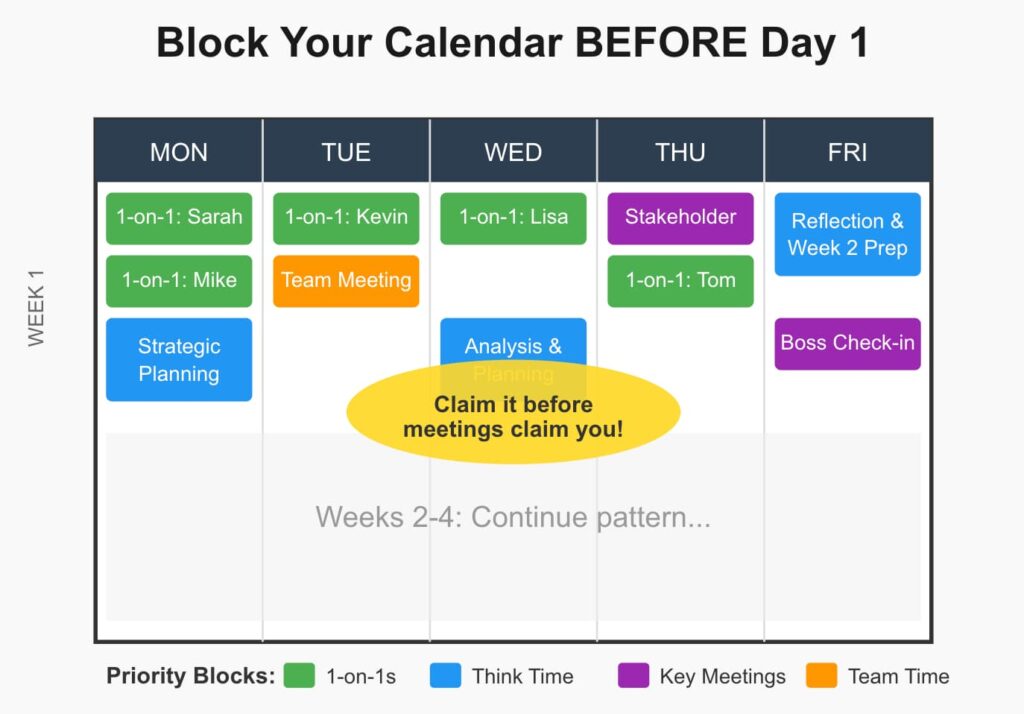
In reality, it is easier said than done. Your calendar fills with crap if you don’t fill it with purpose first. In my experience, the most successful managers are the ones who can clearly draw a line to gain some time for themselves. This means you need to know your own boundaries, which is the next point.
New Manager Tip #8: Set Your Boundaries Before You Need Them
Define Your Availability
Decide before you start:
- Your core working hours when you’re available
- Your response time standards for different communication channels
- Your after-hours emergency criteria
- Your weekend and vacation boundaries
- Your meeting attendance criteria
This is a mistake I personally made in my previous role. I just wanted to be everywhere, every time. When I realized this rhythm could not be sustainable long term, it took me a long time to be able to reverse. Instead, communicate these boundaries in your first week. Be friendly but firm. If you start answering emails at 11 PM in week one, that becomes the expectation forever. Or it will take a lot of time to re-establish the boundaries backwards.
Establish Your Non-Negotiables
Identify what you will and won’t compromise on:
- Weekly one-on-ones with direct reports (non-negotiable)
- Quarterly performance conversations (non-negotiable)
- Last-minute fire drills that aren’t real emergencies (negotiable)
- Skipping lunch to attend meetings (negotiable)
If you don’t set boundaries before starting, you never will. Six months in, you’ll be the manager who works weekends, never takes vacation, and wonders why you’re burned out.
New Manager Tip #9: Create Your Learning Plan (Because Nobody Else Will)
It is still rare to see companies sending people to management roles with management training prior. My view is that your development is your responsibility. Accept it and plan for it.
Honestly Assess Your Skill Gaps
Before you start, identify what you don’t know:
- Have you ever fired someone?
- Can you handle difficult performance conversations?
- Do you understand the basics of the recruitment process?
- Can you create and manage budgets?
- Do you know how to develop talent?
- Can you influence without authority?
For each gap, identify how you’ll close it. Find short courses, mentors, books, or experienced managers who can help. Schedule this learning before you need it, not after you’ve made costly mistakes. Here is a link to my manager development program below:
Explore my manager development program
5 Complete Modules: Introduction to People Management, Goal Setting, Competency Development, Coaching & 1-on-1s, Performance Management in Practice.
New Manager Tip #10: Know the Red Flags That Should Make You Walk Away
Not every management role is worth taking. Sometimes the smart move is saying no to avoid making decisions you will regret. Here are some management mistakes you want to avoid.
Here are the signs you should run, not walk away:
- The company can’t define success metrics clearly
- The last three people in this role lasted less than a year
- The team has over 60% turnover
- The job description changes every conversation
- The problems are systemic but you’re expected to fix them with no authority
- Your boss is checked out or actively harmful
Taking a bad management role is worse than staying an individual contributor. It can derail your career for years. Sometimes the promotion is actually a trap.
The Reality Check
Most companies promote you on Friday and expect you to manage like a pro on Monday. They throw you in the deep end and act surprised when you struggle. That’s their failure, not yours. But it becomes your problem if you don’t prepare.
The managers who succeed do this work before they start. The ones who fail try to figure it out while managing. The difference isn’t talent. It’s preparation.
If you’re just stepping into your first team-lead role, check out this complete New Manager Guide. It covers the fundamentals from goal-setting to feedback and delegation.
Ready to Accelerate Your Management Development?
These pre-start preparations give you the foundation. But management is a skill that requires ongoing practice, feedback, and refinement.
If you want structured support to make this transition stronger, consider the Manager Development Program. Anyhow, make sure you’re ready.
MORE MANAGER DEVELOPMENT RESOURCES
This article is part of our manager development resources.
Stay sharp for Monday
Practical resources to help managers lead smarter, faster, and with confidence.

Free manager resources for new Managers
View Article
The Ultimate Guide for The New Manager
View Article