Key takeaways
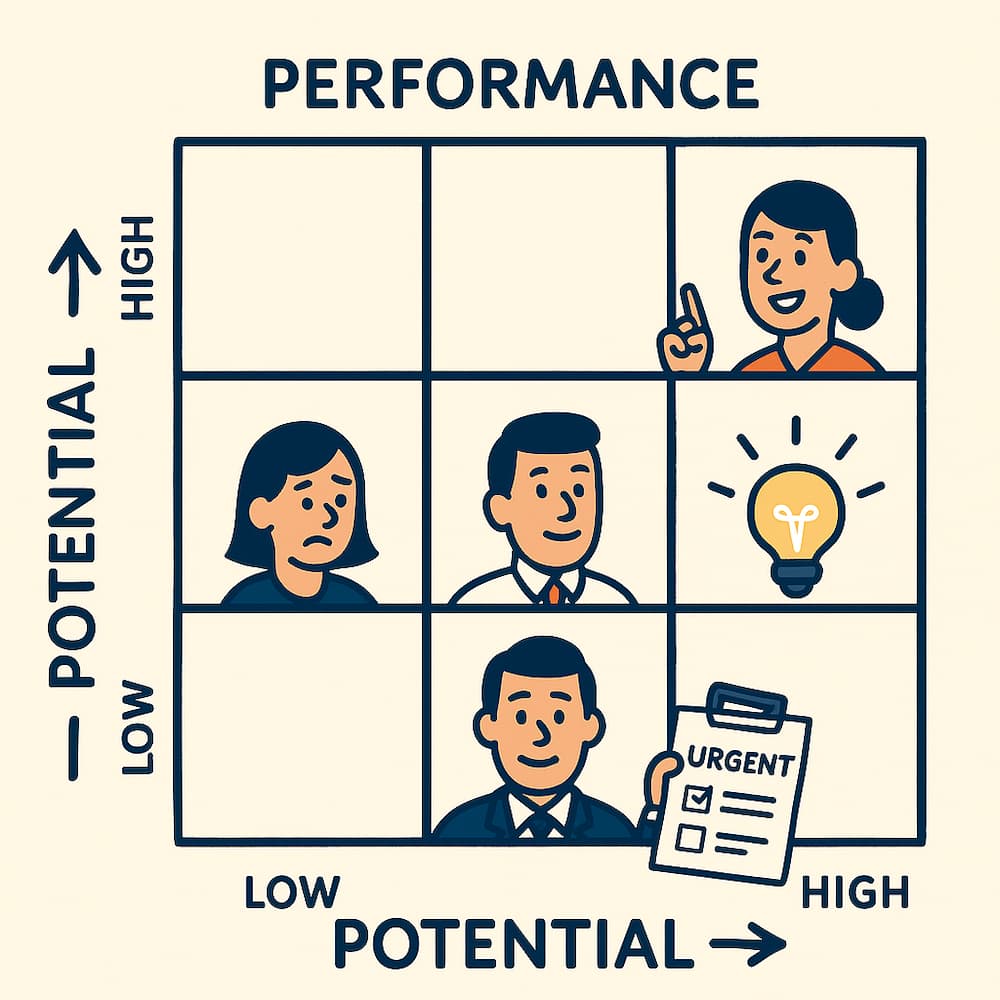
- Map Performance Against Potential: The 9-Box Matrix moves beyond simple performance reviews by adding the dimension of Future Potential. By plotting employees on this 3X3 grid, you can distinguish between your “Stars” (High Performance/High Potential) and your “Workhorses” (High Performance/Low Potential), ensuring you don’t mistakenly promote someone into a leadership role they aren’t equipped to handle.
- Target Development Based on the Box: One size does not fit all in employee growth. Use the matrix to tailor your strategy: “Stars” need high-visibility stretch assignments and leadership grooming, while “Core Players” (Moderate Performance/Potential) need coaching to boost consistency. This ensures you are investing your limited management time and budget where it will yield the highest ROI.
- Build a Robust Succession Pipeline: The 9-Box is your ultimate insurance policy against turnover. By identifying employees with high potential early, you can proactively build a pipeline for key leadership roles. This strategic “Career Pathing” not only prepares the business for the future but also increases the retention of your most valuable talent by showing them a clear, documented path upward.
Table of Contents
The 9 box grid is part of Monday Simon Manager Development Program:
👉 Module 5: Performance management for managers
What is the 9 box Matrix
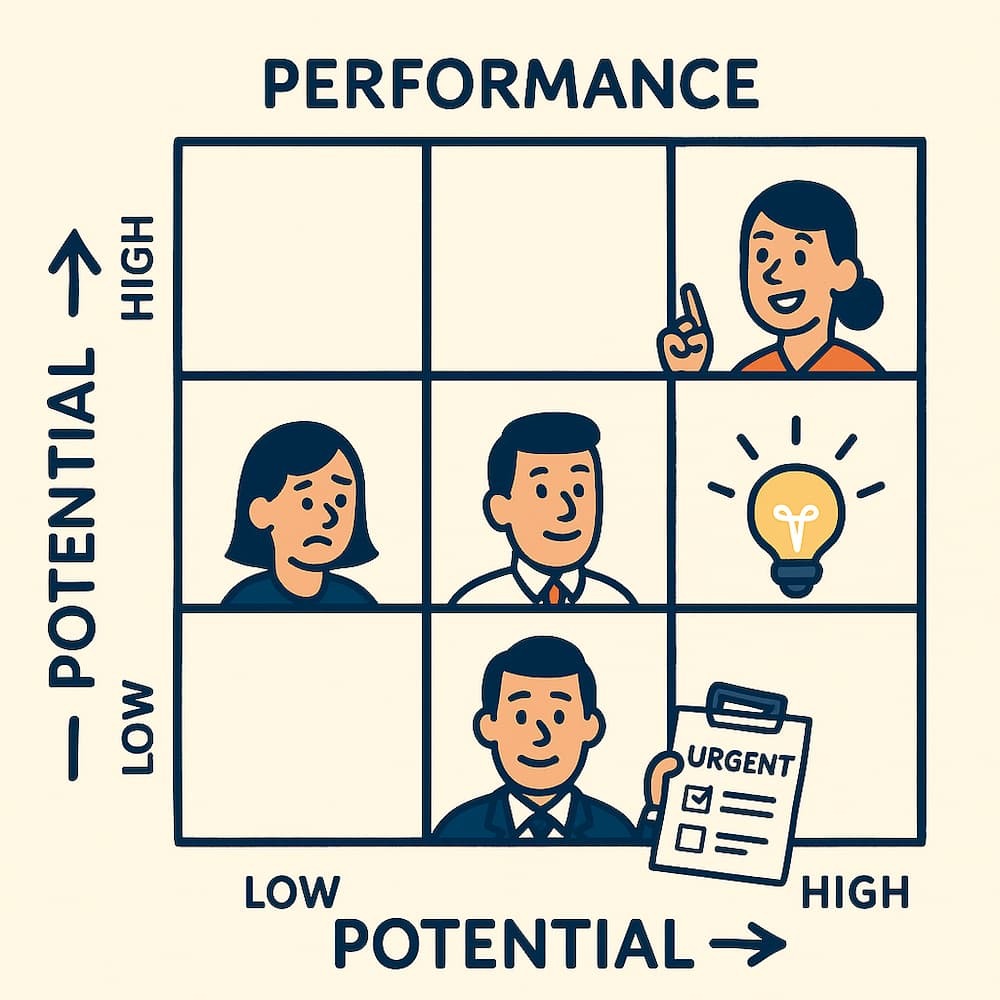
The 9 Box Grid, also known as the 9 Box Model or 9 Box Matrix, is a popular tool used in human resources and organizational development for assessing and planning the development of employees, particularly in the context of leadership development. This tool helps organizations identify potential leaders and determine the best strategies for their growth and development.
I use it in my manager development program to highlight how talents can be categorized. If you are a manager, you do not need to proactively use this tool, but understand how talents can be categorized to focus development.
The 9 Box Grid is a three-by-three matrix that categorizes employees based on two key dimensions: performance and potential. Each axis is divided into three levels, resulting in nine boxes within the grid. Here’s a breakdown of the two dimensions:
- Performance: This axis measures an employee’s current job performance. The levels are typically labeled as Low, Moderate, and High.
- Potential: This axis assesses an employee’s future potential to take on more significant roles within the organization. The levels are also typically labeled as Low, Moderate, and High.
Here are the main employee profiles that usually come out of the 9 box grid:
- The High potential
- The High performer
- The Poor performer
The results usually come from the assessment of KPIs and OKRs, combined with a potential assessment, often conducted using tools such as 360 assessments.
RELATED RESOURCES
You may also find our team development resources useful.
Interpretation of Each Box
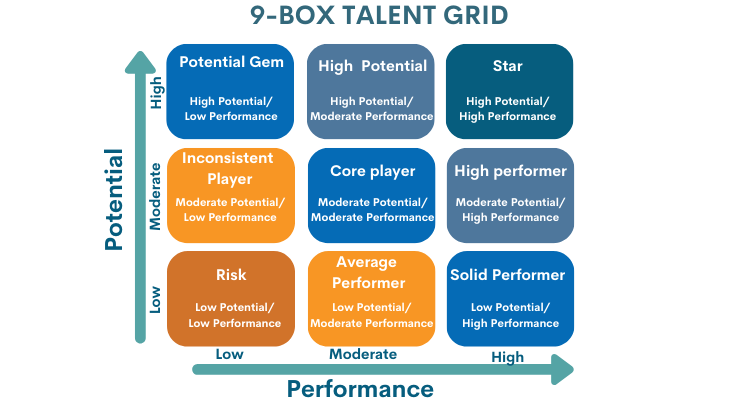
Each box in the 9 Box Grid represents a different combination of performance and potential, and each has implications for development and career planning:
- Box 1 (High Potential, Low Performance): Employees in this box have significant potential but are currently underperforming. Individual Development plans should focus on addressing performance gaps while nurturing their potential.
- Box 2 (High Potential, Moderate Performance): These employees show great potential and moderate performance. Development should aim to boost their performance to match their potential.
- Box 3 (High Potential, High Performance): Often referred to as “stars,” these employees are top performers with high potential. They are prime candidates for leadership roles and should be groomed for future advancement.
- Box 4 (Moderate Potential, Low Performance): Employees here have moderate potential but are currently underperforming. Focus on improving performance while considering their potential for growth.
- Box 5 (Moderate Potential, Moderate Performance): These employees are “solid performers” with moderate potential. Development should aim to maintain performance and explore potential for higher roles.
- Box 6 (Moderate Potential, High Performance): High performers with moderate potential. These employees should be supported in maintaining their performance and considered for roles that align with their potential.
- Box 7 (Low Potential, Low Performance): Employees in this box are underperforming and have low potential for growth. Consideration should be given to whether they are in the right role or if other opportunities within or outside the organization might be more suitable.
- Box 8 (Low Potential, Moderate Performance): These employees perform moderately but have low potential for advancement. Focus should be on maintaining their performance in their current roles.
- Box 9 (Low Potential, High Performance): High performers with low potential. These employees are valuable in their current roles but may not be suitable for leadership positions. Efforts should be made to retain them in their current capacities.
Using the 9 Box Grid for Leadership Development
The 9 Box Grid is a valuable tool for leadership development in several ways:
⁃ Talent Identification
The grid helps organizations identify high-potential employees who can be developed into future leaders. By placing employees in the appropriate boxes, HR professionals and managers can easily see where the organization’s talent lies.
⁃ Development Planning
Once employees are categorized, specific development plans can be created. For example, employees in Box 3 (High Potential, High Performance) might be enrolled in leadership training programs, while those in Box 1 (High Potential, Low Performance) might need targeted performance improvement plans.
⁃ Succession Planning
The 9 Box Grid is instrumental in succession planning. By identifying employees with high potential and performance, organizations can create a pipeline of future leaders to fill key roles as they become available.
⁃ Career Pathing
The grid can also help in career pathing, showing employees potential career trajectories within the organization. This can increase employee engagement and retention by providing a clear path forward.
If you require additional tools to support your manager duties in your company, do not hesitate to review my manager tools.
MORE MANAGER DEVELOPMENT RESOURCES
This article is part of our performance management resources.
Stay sharp for Monday
Practical resources to help managers lead smarter, faster, and with confidence.

High Potential Employees: How to Identify and Develop Your Future Leaders
View Article
High Performers: Your Ultimate Advantage for Team Success
View Article