Key takeaways
- Own the “70%”: Stop treating Individual Development Plans (IDPs) as HR paperwork. Real learning happens on the job. Managers must connect development goals directly to strategic assignments that impact the bottom line. If a skill doesn’t affect the bonus or the business outcome, it won’t be prioritized.
- Recruitment is a Manager’s Job, Not an Admin Task: HR shouldn’t be an “order taker.” Managers must own the Scorecard and Job Description from day one. By implementing a mandatory 48-hour feedback rule and pre-interview alignment meetings, you eliminate “gut-feeling” hires and replace them with data-driven selection.
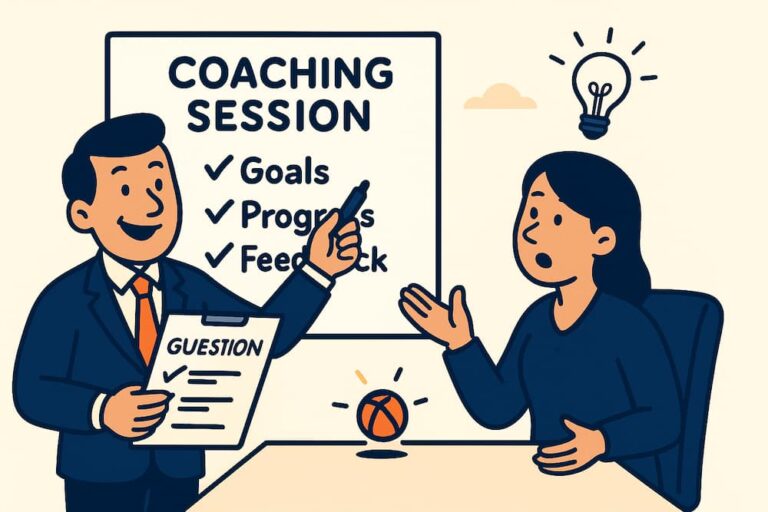
- Standardize Feedback with Two Tools: Don’t let managers improvise. Master only two models: FIAC (Facts, Impact, Action, Commitment) for performance course-correction, and GROW (Goal, Reality, Options, Will) for developmental coaching. This removes the “I don’t have time to coach” excuse by providing a 20-minute structured loop.
- The “Manager KPI” for Accountability: Management is a skill that must be measured. Implement a “Manager KPI” by grading them on the quality of their SMART goals, the frequency of their 1-on-1s, and the accuracy of their documentation. It forces consistent habits. If you don’t measure management quality, you reward mediocrity.
Table of Contents

The real HR issues behind HR frustration
There is a common misconception that tends to push the ball into HR’s court for every systemic failure in the organization, and this is often how HR issues get wrongly called out.
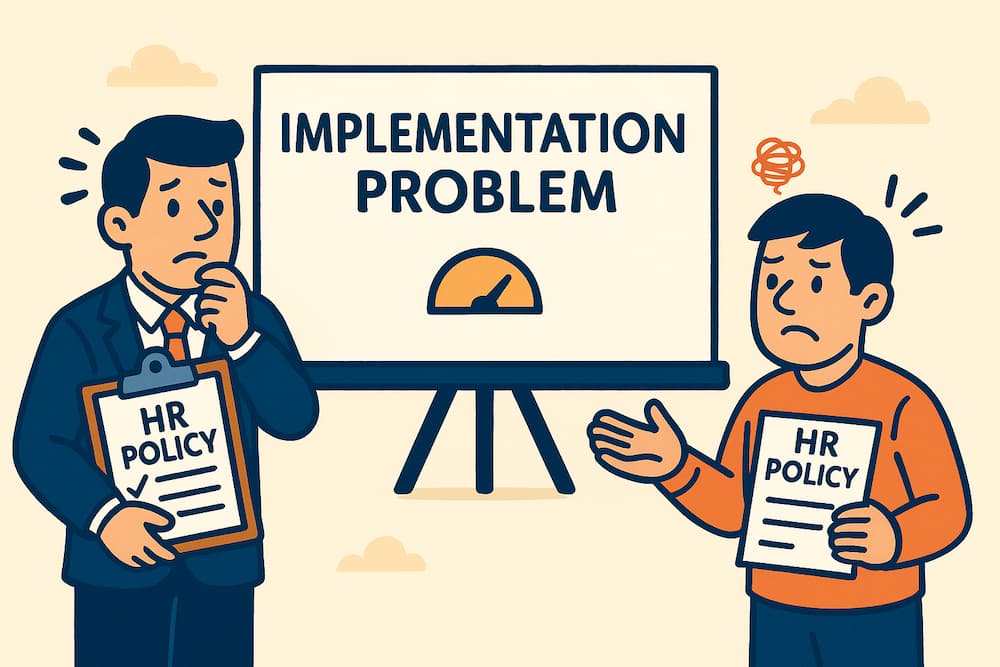
The point here is that every organization has its own challenge. I am personally convinced that more often than not HR initiatives do not fail because of strategy. HR fails because managers do not implement.
It is not so much a matter of “HR does not do its job”. I have seen too many companies with perfect global processes, but the implementation is… Non-existent.
HR builds frameworks. Managers ignore them or don’t use them. And this is exactly why so many organizations experience recurring HR issues that have nothing to do with HR at all.
The Silent Gap Between HR Intention and Manager Reality
If we look at the issue with attention, there are recurring situations that can be prevented. These HR issues are often borne in how the company has been used to operate.
For example:
Most managers are promoted for performance, not management capability. This is already a default signal that says a lot about the disconnection between your leadership framework and reality. And in a manager’s mind it may sound like “why should I care?” “Leadership did not bring me to where I am today, and it won’t bring me to where I want to be.”
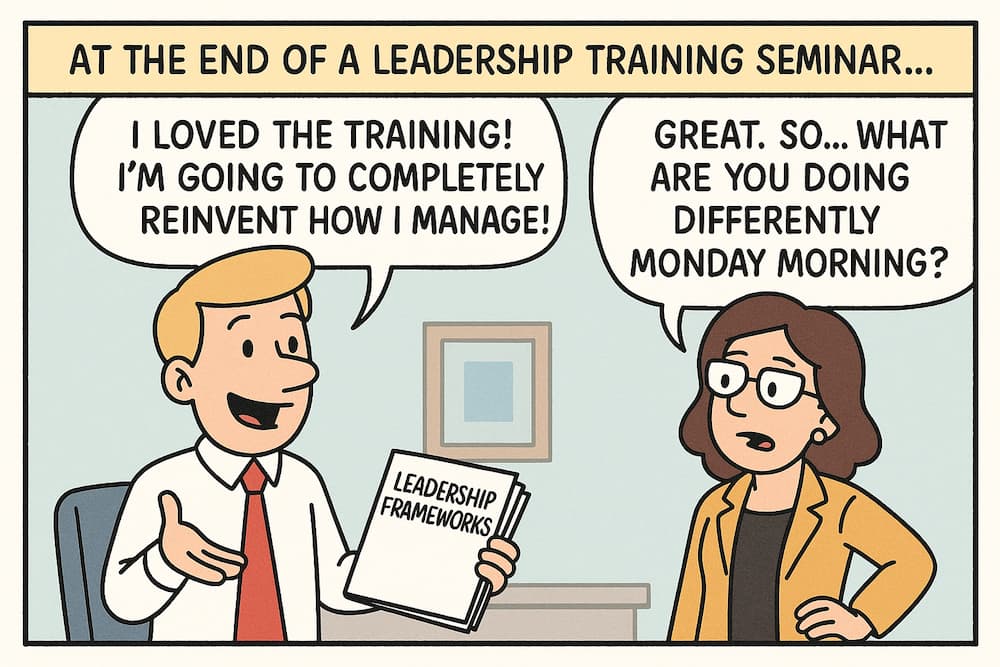
When HR puts in place frameworks, they often fall in the trap of poor execution. Policing should exist at least at the beginning of a new implementation. I am in for a strong controlling function although controlling alone is not enough for adoption. A good starting point first is to first check that if we do not have just too many policies. Why not rationalize and go all out on implementation for the most important ones.
But where does this lack of adoption come from? Are we pushing too much too fast? Managers want results, not frameworks. A clear example is the performance management process: many managers don’t even take the time to update the system, or to sit down with their team members for proper review conversations. But they would all agree they want better performance.
Regardless :
- Managers provide unclear goals
- Feedback is not documented
- Promotions are not fact based
The list goes on.
Not to throw HR under the bus here, but these have led HR to lose focus on the real impact of their policies. It might fall only under the control spectrum to back themselves up. But it also lost the primary intent: the outcome, which is why many of these situations later show up as HR issues.
And even at the edge of AI, we are still not doing a pretty good job here to embark managers in a simple journey that makes HR prove the outcomes of the processes.
The buy-in on the surface is here. If you ask any managers, most likely they will agree with you if you say “write a development plan” for your employee. Yet why is this not done yet?
Managers need to understand what their duties are as much as HR needs to understand how to better serve their performance.
So all roads lead to Rome. And Rome in my view is better managers. Without fundamentals, even the best HR systems fail. Before you send out employees to fancy leadership programs, go back to the good old book of management 101 for dummies, I mean it.
Preventing HR issues only comes down to one thing: Implementation.
I am writing below a set of common fails when it comes to the implementation with some practical tips to understand how to improve.
Pain Point #1: Managers Never Implement Your IDPs Design
The IDP is a typical symptom of the HR / Manager struggle. I chose this one deliberately because it matches the organization of level maturity 2 described above.
Managers understand they need to develop subordinates, yet they are still not doing it.
HR is laying out a process that looks nice on paper. All the forms and templates are there, yet:
- IDPs filled once
- Goals are vague (“Improve communication”)
- No 1:1 follow-up
- No development habits
- HR forced to “chase updates”
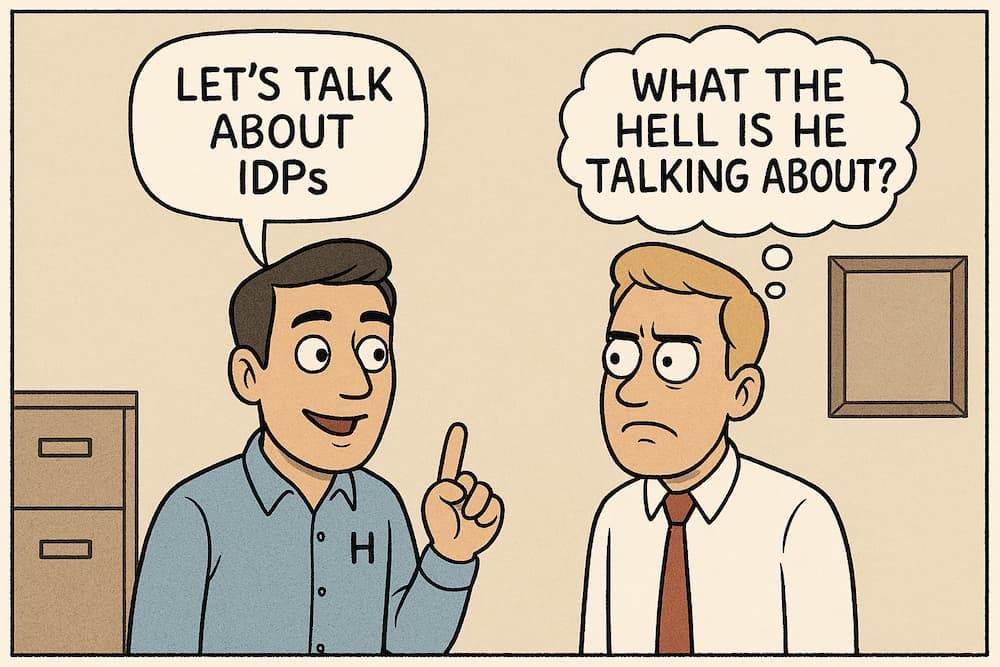
- Root cause #1: It sounds too much like HR, disconnected from work.
- Root cause #2: Managers do not know how to coach.
- Root cause #3: Managers avoid development because it feels like “extra work”. “I don’t have time”
Consequence: No skill growth, no ready talent, no succession. HR owns development alone, and we fall into the trap described at the beginning: the policing trap.
And here I see you coming. You may argue that the company culture doesn’t prioritise development and retention over short-term objectives. You’re probably right. But unless you plan to change your CEO, the odds are it won’t shift anytime soon, and the CEO is rarely around when you need them to fix your HR issues.
And I would respond to you: Start with what you can practically influence. Development is a manager’s job.
So, how to ensure an IDP implementation? (GROW + IDP + monthly follow-up), Compliance = natural habit.
Several things:
Key #1: First, start by training the managers to the basics of coaching with the GROW model. If you choose one tool, choose this one, that’s all.
Key #2: Clarify the expectations of the 1-1.
Implement a systematic structure of 1-1 that includes performance and KPI / OKR tracking. I prioritize the same 1-1 structure. Otherwise, managers consider it time wasted. Long story short 1-1s should be 20 min. You don’t always need one hour, a good structure is:
- Ice breaker
- Short KPI review and feedback
- GROW model for development
- Give / receive feedback
- Close with commitment
Key #3: Embed the IDPs in the action plan of a competency in your performance management system: make it count for the bonus and salary increase. By doing so people are not so different from you, they work for their development for sure but most importantly for the end of the month paycheck.
If you do not have a competency system in place, no excuse, embed it as an action plan as part of a KPI achievement.
Key #4: Most importantly, understand the foundations of the 70/20/10 framework. 70% of the learning is done on the job, 10% with formal learning, 20% social learning. So here, you leverage more chances to convince someone to learn if it is connected with the daily job, or strategic tasks to actually do (and daily job count for bonus and salary increase).
The way to explain it to a manager: An IDP is an action plan to develop a competency. That’s all. It is relevant for the career path, and it counts for the bonus.
Note: there are several types of IDPs but I will come back to that point in a future article.
Pain Point #2: Managers Do Not Follow the Recruitment Process
Here’s another classic: the recruitment process that exists on paper but dies in practice.
Every HR and TA professional knows this dance. You build a beautiful recruitment framework with structured interviews, scorecards, and clear processes. Then Monday morning arrives and what happens?
- Hiring managers bypass structured interview guides
- They send vague JD requirements (“Find me someone good”)
- They choose based on gut feeling
- They skip scorecards
- Interview notes = nonexistent
- HR needs to chase to collect feedback
I think this is the area that gets minimized the most. Very few companies do recruitment training to start with. And it takes a lot for a manager to admit “I have never been trained.” So instead, they put the excuses aside and wing it. Every. Single. Time.
The likely culprit here is that there is no enforcement from the management chain. What are the consequences for a bad hiring process? Usually nothing.
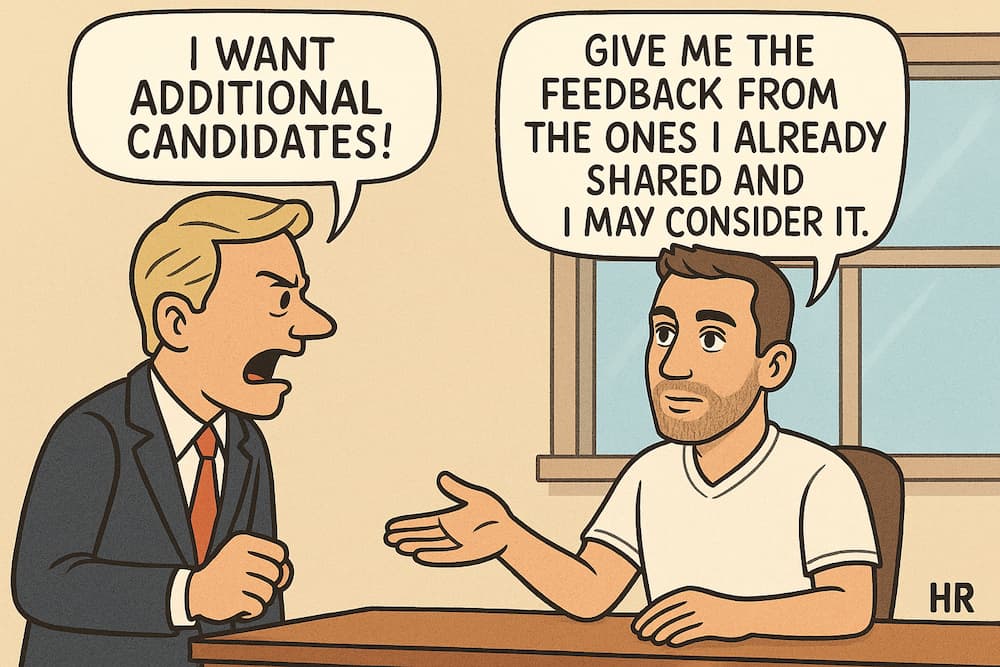
The collaboration turns into a pure admin exchange, and HR ends up in the trap of simply “taking orders.” It becomes a ping-pong of emails where HR is completely disconnected from the real decision-making. And the worst part? There are no consequences for bad hires. The manager who made the wrong choice just shrugs and moves on.
So what’s the fix to these HR issues?
Stop thinking it’s “HR’s job with manager participation.” Flip it. It’s the manager’s job, and HR is there to support.
Here are key items to support the implementation:
Key #1: Make your managers do the scorecard at the personnel request AND write the job description themselves. The personnel request form or whatever you are using should merge these 3 outputs below and fall on the manager’s shoulders (not HR) :
- The request form
- the JD
- the scorecard
Merge the admin burden, whether it’s online or offline. If they want to hire, they do the work. Period.
Key #2: Train managers on the essentials and the structured interview as the very first thing. Not optional. Not “when they have time.” Before they can post their first job.
Key #3: Alignment meetings are mandatory. When the personnel request form is expedited, then there MUST be a human touch with HR: At least a 20-minute recruitment alignment meeting plus a simple scorecard removes 80% of errors. That’s it. Twenty minutes. Have HR meet with the manager in person (yes, in person) and make the manager finalize the job description and align on the requirements. Right there. Together.
Key #4: Ensure managers are challenged during the process. HR is not the order taker. You are the quality control tower. Ask the hard questions: “What specific skills will you test for?” “How will you measure success during the probation period?”
Key #5: Implement rules to push the process forward: Implement a 48-hour feedback rule. No feedback in 48 hours? The candidate moves on. And here’s the one that really gets attention: if there are a few weeks with no feedback from the hiring manager, cancel the hiring. Yes, cancel it.
Overall, take the manager through a cycle with clear touchpoints. Recruitment becomes a shared responsibility: “I do my work, you do yours”.
Pain Point #3: You Provide Learning Opportunities But Nobody Learns
This one makes my blood boil. Companies spend millions on learning platforms and then wonder why nothing changes. Yet they persevere in spending more.
The symptoms of this HR challenge are everywhere:
- Perfect LMS sitting there
- Great course library that costs a fortune (ie linkedin learning, Udemy, coursera etc)
- Zero application at work
- Managers still adopt the wishlist mindset (“I want my team to take communication training”) but there is no relevance on the job requirements
- Employees watch videos like Netflix (when they actually do) without applying anything
- Managers never ask, “How will you apply it?”
Usually, what happens here is that training becomes a cost center, not an investment. HR must justify budgets every year with increasingly creative presentations. Meanwhile, employees get frustrated because “nothing ever changes around here.”
My point of view is that companies should train less, but focus their training instead.
Key #1: Remember the 70/20/10 framework I mentioned earlier? Use it. Stop pretending that courses alone will change anything. 70% happens on the job – so make learning part of the job, not separated from it.
Key #2 :Kill the wishlist approach immediately. No more “I think Sarah needs presentation skills.” Instead, assess actual gaps against real competencies. What are competencies and skills required for the role? What are the gaps? What business outcome will improve? If you cannot answer these questions, you do not have a training need – you have a manager avoiding a difficult conversation.
To eliminate the wishlist mindset, start by assessing real competency gaps instead. You have many tools for this, including my 360 Leadership assessment tool, which you can fully customise to match your own competency framework.
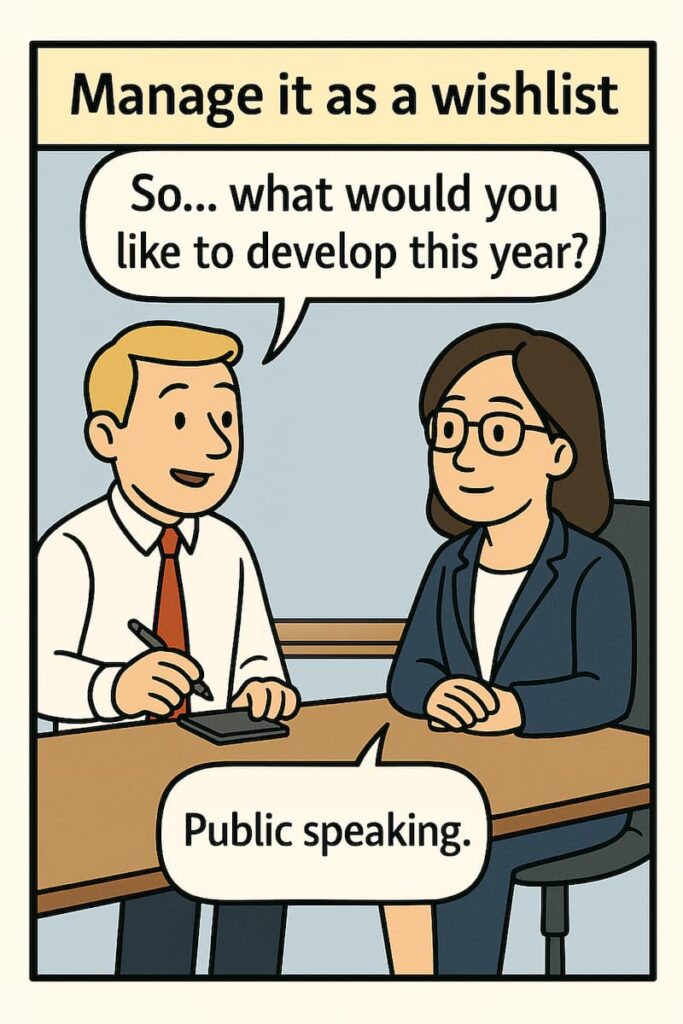
Key #3: Get full control of the competency list and rationalize what needs to be learned. If you have a competency framework, rationalize it. If you don’t have it, think twice before having one, it might not be your utmost priority.
Make the direct link to the competency framework, not what the learner or manager wants systematically. The issue is that when someone senior says, “everyone needs agile training” and suddenly it’s mandatory. Stop it. Challenge it. Ask “which specific competency does this develop”, “What performance is expected” is it aligned with the performance goals of our staff? Otherwise kill the initiative.
Key #4: Most importantly, embed the training in the action plan of the performance management process. If it’s not in the performance review, it’s not important. If it doesn’t affect the bonus, it won’t get done. This is human nature. Use it instead of fighting it. I am surprised this is still not done in most companies. Learning happens outside the performance process, where in reality, Learning is all about performance management (or at least its vehicle).
Last time I checked, Netflix is cheaper than your LMS. So either make learning drive real performance or stop pretending you have a learning strategy. You have a video library. There’s a difference.
Pain Point #4: Goals and Feedback Are Not SMART and Fact-Based
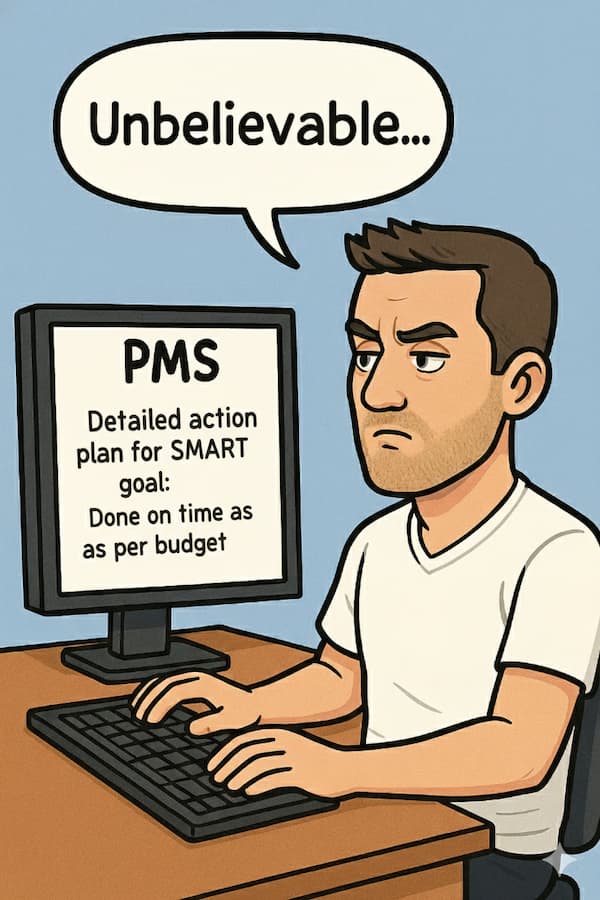
This one is a classic. Most managers know the SMART concept, but how many actually implement it? Really implement it, not just claim they do?
Here’s what I see in reality:
- Managers update the performance management system once a year (if we’re lucky)
- Goals are not SMART
- No action plans in front of KPIs or OKRs
- The system has incomplete comments: “delivered on time as per budget” in the action plan sections
- Managers give opinions, not fact,s and do not document them
- Promotions and terminations happen without documentation
- They avoid tough conversations
- Employees are “surprised” at year-end
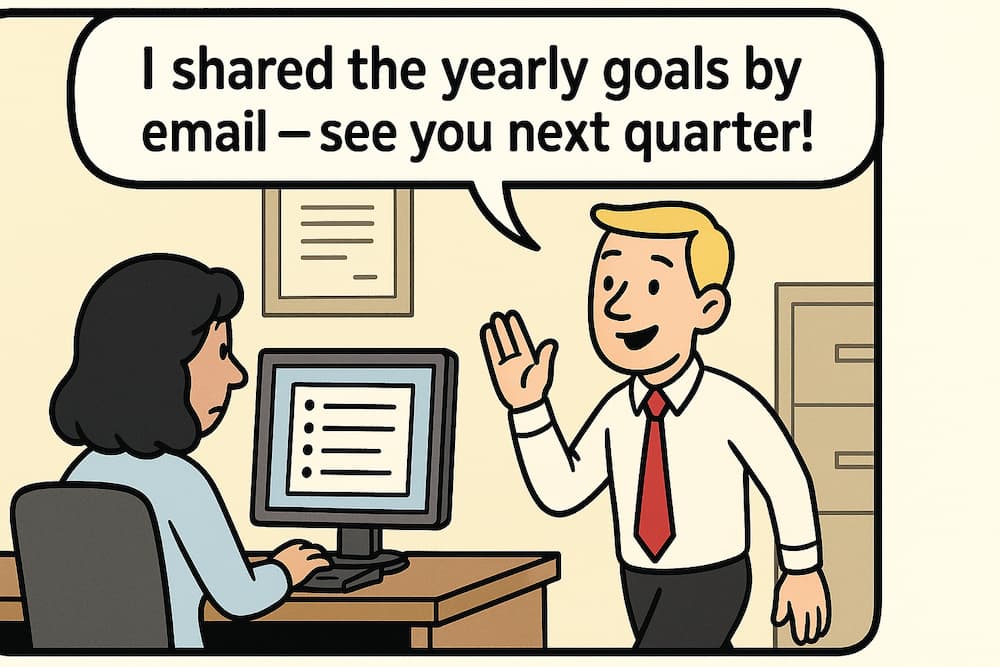
And in the end, HR becomes the mediator when shit happens. The consequences are killing organizations slowly:
- Poor performers are protected because there’s no documentation
- High performers leave because they see incompetence rewarded
- Year-end calibration becomes absolute chaos
- HR must fix what managers didn’t do all year
And then we wonder why the performance management process “doesn’t work.”
When it comes to performance management, I advocate for strong quality control on managers. Especially if you’re installing a new system. Start with strong control and then loosen it as time goes by. Not the other way around.
Key #1: Control that goals are SMART with actions, and do it again. Every single goal must be Specific, Measurable, Achievable, Relevant, and Time-bound. If it’s not, send it back. Click here to access my sampled KPI library.
Key #2: Require at least 2 competencies per employee to be actively developed VS the gaps or for the key requirements of the role. Not 10. Not 5. Two. But those two must have clear action plans, regular check-ins, and measurable progress. Quality over quantity, always.
Key #3: Have a mandatory 1-1 section per manager – ideally every month, if not per quarter, with the structure I’ve shared earlier. This is non-negotiable. Block the calendars. Make it happen. The managers who say they don’t have time? They’re the ones who need it most.
Key #4: Teach two feedback models and only two:
- FIAC for performance feedback (Facts, Impact, Action, Commitment)
- GROW for development coaching (Goal, Reality, Options, Way forward)
That’s it. Master these two and you’ve solved 90% of feedback problems.
Key #5: Make a commitment of 1-2 years of systematic control before loosening it up. Yes, it’s intense. Yes, managers will complain. But this is exactly what I used to implement, and it works.
There are now several tools to check the consistency of managers’ outputs. I created a full set of resources in my Manager Tools. And if these tools don’t exist internally, you can use my custom ChatGPT to double-check SMART goal implementation.
Are you brave enough to implement a manager’s KPI?
Next, I am sharing my control sheet as an example of what I call the manager KPI. This tool helped me fix several recurring HR issues and ensure real implementation with managers. I used to implement the “manager KPI” in my previous organisation to control the above. I am sharing it here, knowing that it can be adapted to different organisations. The principle of it is that if you are a manager, you need to know how to manage, so you have a manager KPI. As a matter of fac,t it was easy to convince my CEO about this initiative at the time. And since we wanted consistency, we went with it.
The Manager KPI: an unconventional solution to your HR problems.
I am sharing below my control sheet when I was in charge of controlling performance management output.
Here is what it looks like on a grid:
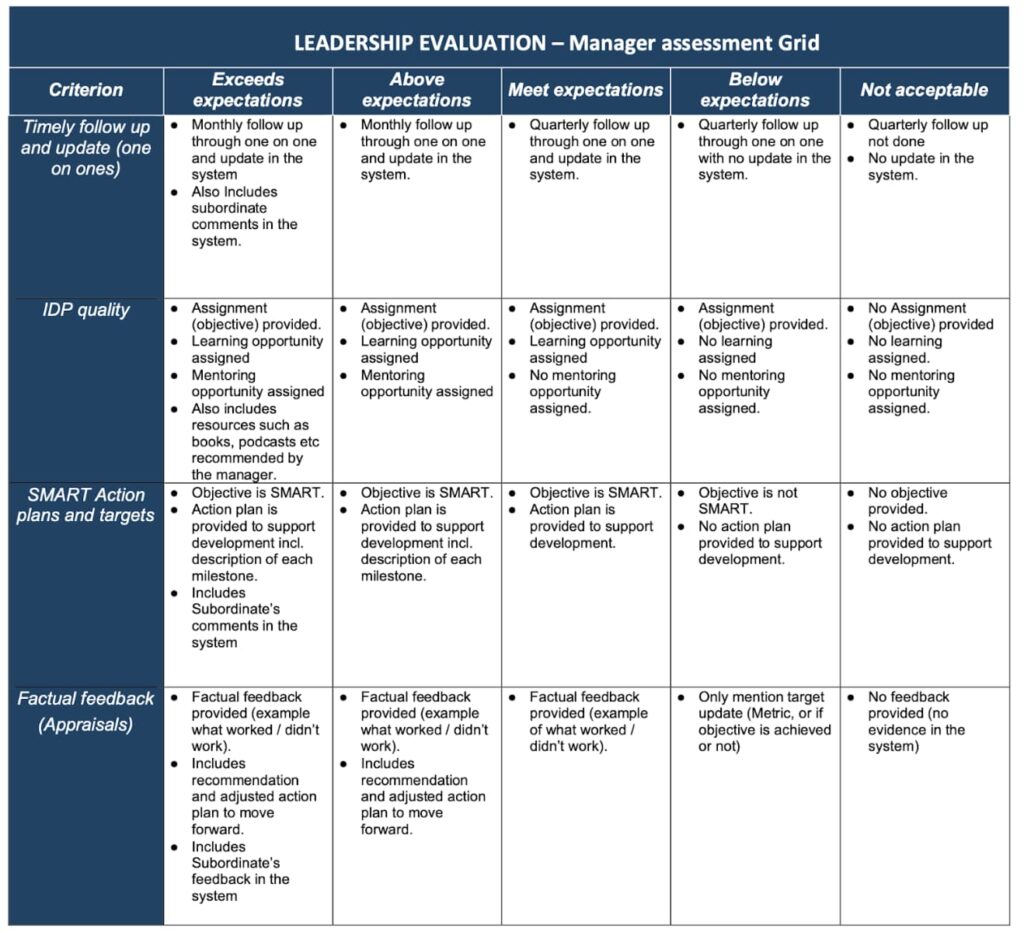
When I implemented it, every manager had a grade that us HR had to review. Bold, but it worked to implement consistent performance management all across the company.
The Pattern: This is Not a Policy Issue. It is a Manager’s Capability Issue
Connect the dots with me here:
- IDPs fail because managers cannot coach
- Recruitment fails because managers do not use a structure
- Learning fails because managers do not follow up
- Feedback fails because managers avoid or improvise
The enemy is not your process. The enemy is inconsistent management habits. Habits require clarity and should be enforced in order to be consistent.
We promote managers without fundamentals, then blame them for not applying frameworks they never mastered or even see value in using. We expect them to magically know how to develop people, run structured interviews, and give meaningful feedback. When they fail, we create more policies. More frameworks. More controls.
Wrong approach.
You do not need more programs. You need managers who apply the fundamentals consistently to avoid recurring HR issues.
The numbers don’t lie:
- Micro-feedback habits = 30% drop in silent resignations
- Structured 1:1s = immediate engagement improvement
- GROW coaching = managers speak less, employees own more
This is what works. Not another leadership model. Not another framework. Just managers who can actually implement what you’ve already designed.
Download My Manager Playbook Summary
This playbook shows you how to convert HR problems into concrete manager behaviors. Download it to access actionable solutions across Recruitment, Performance Gaps, Learning & Development, and Performance Management.
The Monday Simon Approach: Turning HR Intent Into Manager Action
You need managers who can actually implement what you already designed. That’s exactly why I built the Manager Development Program. Not to add another initiative to your list, but to finally make your existing ones work.
Most recurring HR issues can be prevented with one thing: implementation.
The program combines online learning, actionable assignments, and practical hands-on support to ensure managers apply what they learn and follow through.
Here are fundamentals module the Manager development program is designed around :
1. Setting SMART Goals and Objectives You can’t inspire your team toward a vision if you can’t translate that vision into clear, actionable goals. Learn how to break down strategy into objectives people can actually execute.
→ If you want to strengthen your managers’ fundamentals, explore my people management training to build the core skills every leader needs.
2. Creating Individual Development Plans (IDPs) Leaders develop people. But first, you need to know how to create a development plan that actually works. Not theoretical career planning. Real skill-building that drives performance.
→ To improve how managers set expectations, learn the SMART method in my goal setting for managers module.
3. Giving Effective Feedback. Want to inspire? Start by mastering feedback. You can’t coach, mentor, or motivate if you can’t tell someone what they’re doing well and what needs to change. And you need to do it in a way that doesn’t destroy trust.
→ To help managers grow stronger teams, my team development training teaches how to identify competency gaps and build effective IDPs.
4. Leading Coaching Conversations Coaching is where management meets leadership. It’s not just telling people what to do : it’s helping them think for themselves. But you need a framework, not just good intentions.
→ If you want managers to coach instead of micromanage, my coaching for managers program provides simple frameworks to guide conversations.
5. Running the Performance Management Process. Performance reviews aren’t just HR paperwork. They’re your chance to align expectations, recognize growth, and address problems before they explode. Get this right, and everything else gets easier.
→ To make performance reviews meaningful, my performance management for managers module shows how to align goals, assess progress, and act early.
6. Recruiting the right people
Explore my manager development program
5 Complete Modules: Introduction to People Management, Goal Setting, Competency Development, Coaching & 1-on-1s, Performance Management in Practice.
HR can Design The Best Systems, but Only Managers can Make Them Work
Let’s stop pretending the problem is your HR strategy. Your strategy is probably fine, BUT:
- It is not enforceable with clear checkpoints
- Managers are not trained.
Implementation is the real battlefield that prevents HR issues. Manager capability is the missing link. Fix manager fundamentals to ensure HR programs work. Your IDPs get used. Your recruitment process is followed. Your performance management drives actual performance.
This isn’t rocket science. It’s discipline. It’s consistent. It’s giving managers the practical tools they need and holding them accountable for using them.
Ready to fix your HR issues?
Explore the Manager Development Program. It is designed for busy managers. 4+ hours with practical assignments AND my support.
MORE MANAGER DEVELOPMENT RESOURCES
This article is part of our manager development resources.
Stay sharp for Monday
Practical resources to help managers lead smarter, faster, and with confidence.
The Recruitment Process Made Simple for Managers
View Article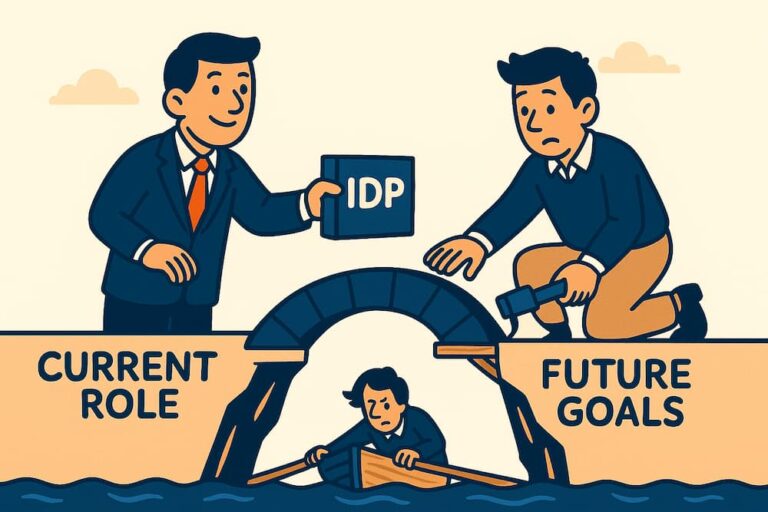
How to Create an Effective Individual Development Plan (IDP)
View Article