Key takeaways
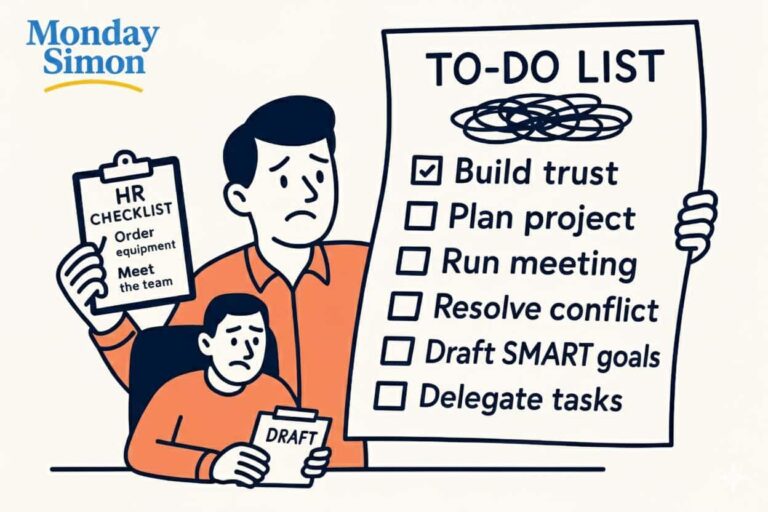
- Kill the Hero Manager: Your success is no longer about your own output; it’s about the output of your team. Stop trying to prove yourself by fixing every problem personally. If your team can’t perform without you in the room, you aren’t managing, you’re just micromanaging toward burnout.
- Translate Ambiguity into SMART Goals: Vague instructions like “be more proactive” kill performance because nobody knows what “good” looks like. Give your team a finish line they can actually see by setting 3–5 specific, measurable goals that connect their daily grind to the company’s bigger mission.
- Master the FIAC Feedback Loop: Don’t avoid tough talks or drop “truth bombs.” Stick to the Fact, explain the Impact, Ask for their perspective, and agree on how to Continue. Fast, factual corrections delivered in private beat a “perfect” annual review every single time.
- Treat 1:1s as Non-Negotiable Maintenance: A one-on-one is where you catch issues before they explode and build real trust. Canceling these meetings is like skipping maintenance on a plane because you’re “too busy flying”; eventually, you’re going to crash.
- Delegate the Outcome, Not the Process: Tell your team what success looks like and why it matters, but let them own the how. Defining every single step kills initiative and trains your team to stop thinking. Give them the context and the goal, then get out of the way.
Table of Contents
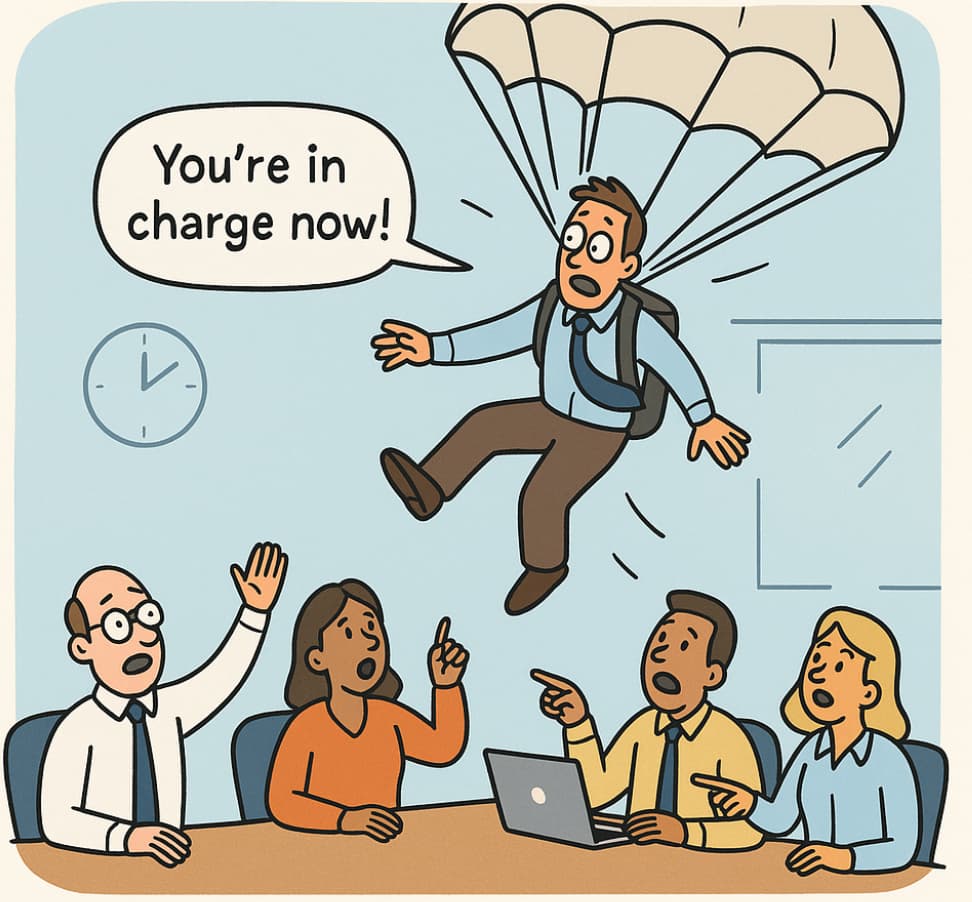
Becoming a new manager is one of the hardest professional transitions you will ever face. The skills that got you promoted speed, expertise, individual performance are not the skills that will now make you succeed. Yet, almost no organization prepares you for the shift. You’re told to “lead,” “communicate,” and “set the example” but rarely how.
I write this guide as a practical roadmap built from real management trenches on how to set direction, give feedback that sticks, build trust without burning out, and make your team actually perform.
1. What Nobody Teaches You About Becoming a New Manager
From “Doing” to “Enabling”
The biggest mental shift for any new manager is realizing that success no longer comes from your output. It comes from the output of others.
This feels uncomfortable. You were promoted because you were great at doing. Now you must create the conditions for other people to succeed. That means less control, slower feedback loops, and higher emotional load.
Ideally you want to be in a position to anticipate what’s coming ahead of you before your new manager role. Learn more about New manager tips.
The Hero-Manager Trap:
Most first-time managers try to prove themselves by fixing everything personally. This is a common trap to come across “likable” by the teams. It feels faster to win hears and it you can get quick praise for it. Your team thinks “You have my back”. But it silently trains the team to wait for you to save them. The long-term result is burnout, dependency, and mediocrity.
Your new definition of success: “I succeed when my team performs well without me in the room.”
Monday-Morning Test: Open your calendar. Highlight every task that could be done by someone else. Start planning the hand-off. Management begins when delegation starts.
The Invisible Curriculum of Management
There’s a hidden syllabus nobody hands you:
- Feedback. How to tell someone they’re failing without destroying trust.
- Prioritization. How to focus the team when everything feels urgent.
- Team goal setting. How to write SMART goals for the team when you were used to handling your individual goals only.
- Coaching. How to ask questions that make people think.
- Recruiting. How to create a recruitment process for the first time and avoid the top recurring mistakes.
- Boundaries. How to protect your time and energy so you don’t drown in noise.
Most new managers learn these by painful trial and error. This guide accelerates the learning curve.
2. Clarity Before Charisma: How a New Manager Sets Direction People Can Follow
Why Vague Goals Kill Performance
Teams don’t fail because people are lazy; they fail because they don’t know what “good” looks like.
Common vague goals:
- “Improve quality.”
- “Increase engagement.”
- “Be more proactive.”
None of these mean anything measurable. A new manager must translate abstraction into clarity.
Write SMART Goals That Humans Understand
Don’t get lost with complex directions and prioritize SMART goals. SMART means Specific, Measurable, Achievable, Relevant, Time-bound.
A clear goal sounds like this:
“Reduce sales cycle time from 100 days to 60 days by December”
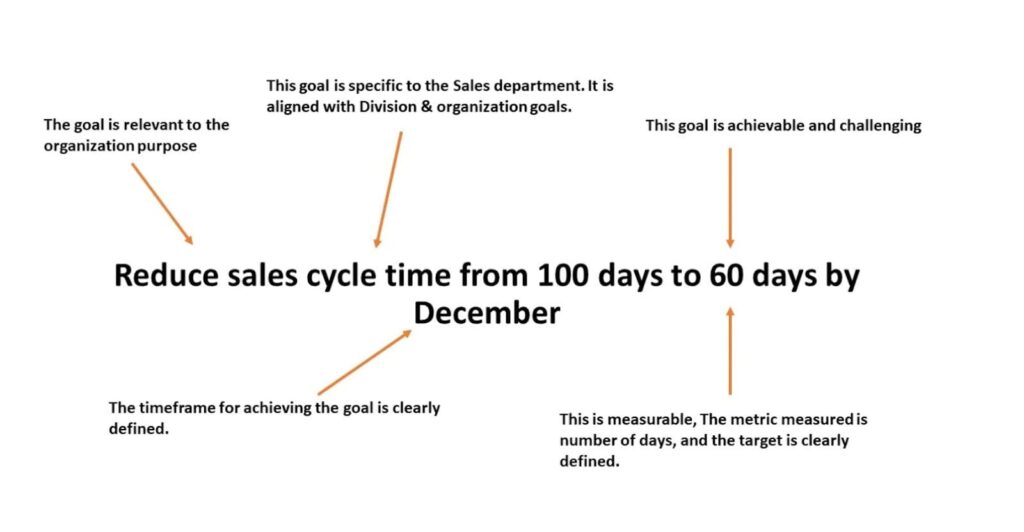
That’s tangible. Everyone knows the finish line and the timeline.
The practical flow:
- Identify the top three outcomes that truly move the business.
- Rewrite them as SMART goals.
- Assign clear owners.
- Review progress weekly, not yearly.
When setting goals, do not get carried away. My advice is to set at least 3 measurable clear goals rather than 6-7 that are not properly defined.
Connect Team Goals to Company Direction
Good managers translate strategy into action.
Ask your boss three simple questions:
- “What are the top company priorities this quarter?”
- “How does my team contribute directly?”
- “How will success be measured?”
Once you know that, repeat it to your team, often. Repetition builds alignment BUT do not delegate the department goals to your team either. Understand the contribution of each individual to each collective goals instead. Otherwise you will unload unfair expectations on your team’s shoulders.
Monday-Morning Test: Pick one fuzzy team goal and rewrite it into a SMART one today. Share it in your next team meeting and ask, “Does everyone understand what success looks like?”
3. Build Development Plans That Keep Your Team Growing
Team members stay motivated long term because they see what’s in there for them under your supervision. And granted, it‘s not all about money. You can keep someone short term with an interesting salary and incentive plan, but you will struggle to retain them on the long run. Is your team developing their career in a direction that meets your department’s objective?
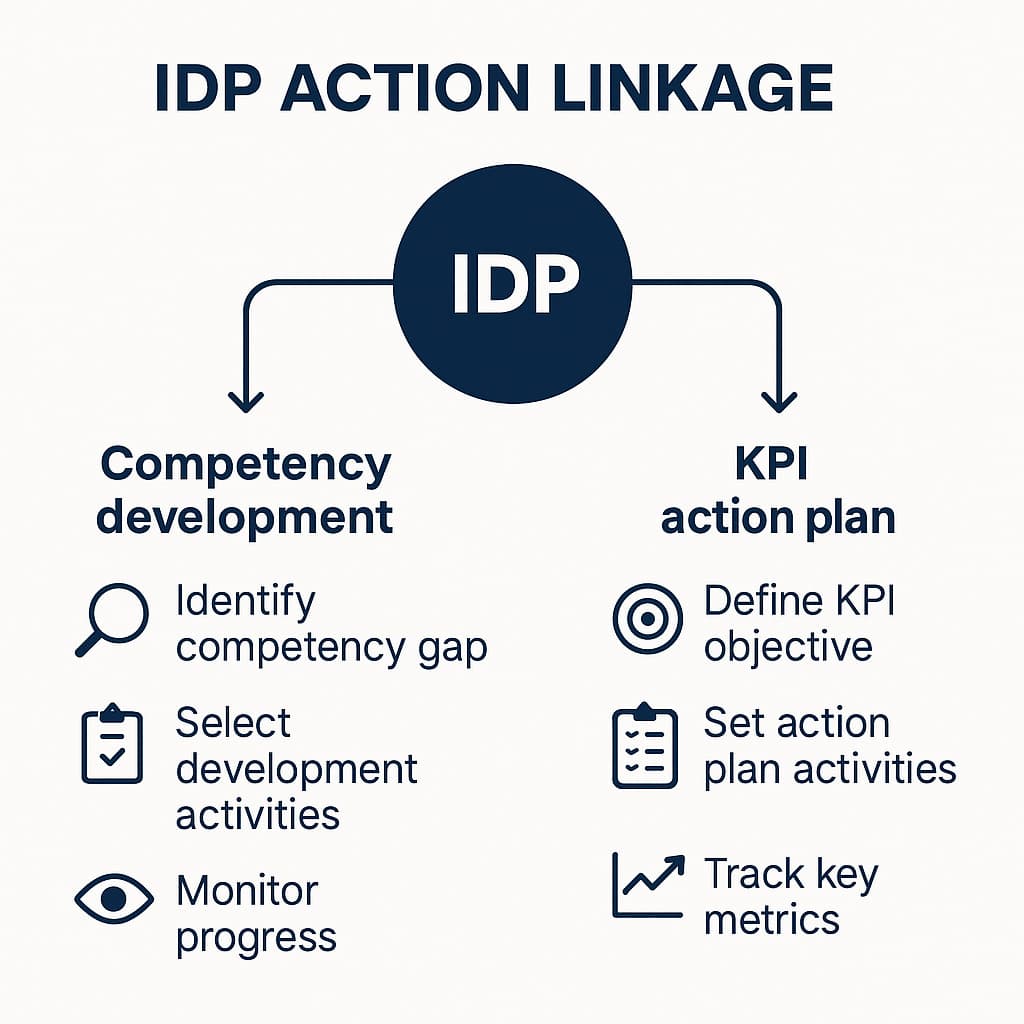
Your duty as a new manager is to identify which competencies need to be developed and to create an action plan for it.
My advice is to not create a lot of development plans for too many competencies, build a few that matter only.
Ensure :
- Competencies selected meet a future career path in case you are dealing with a high performers
- Competencies selected meet foundational competency requirement needs in case of a medium performer (have them meet current expectation first).
Once identified, craft an Individual Development Plan. This development plan must be reviewed each time you perform a one on one with your team and adjust the results. As you go.
Here is a link to my IDP template.
Once the IDP is created, ensure it is linked to both KPIs and OKRs.
4. Feedback: The Skill That Defines Every Great New Managers
Why Feedback Fails So Often
Most new managers either avoid feedback or deliver it so harshly that the team shuts down. As a general rule:
- Avoiders hope problems fix themselves. They never do.
- Over-correctors drop truth bombs and damage trust.
Effective feedback is clear, fast, and respectful. It’s a skill, not a personality trait.
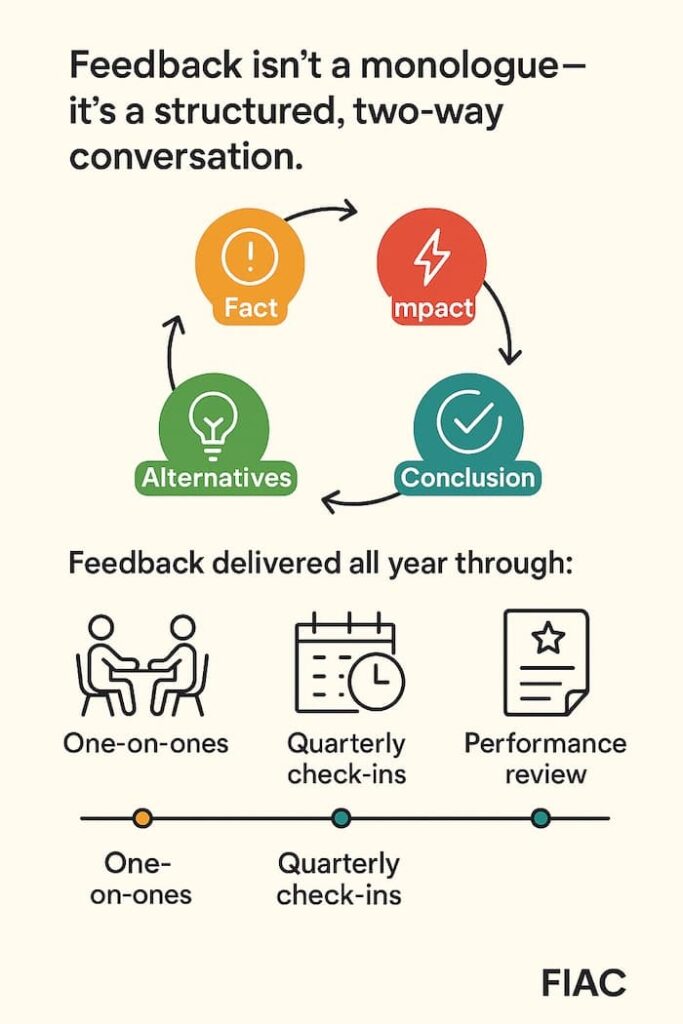
The FIAC Framework: Fact → Impact → Ask → Continue
A simple method that keeps conversations factual and forward-looking is the FIAC Feedback. Remember it by heart, especially to give tough operational feedback.
- Fact: Describe what happened—no judgment.
> “You missed the client update on Tuesday.” - Impact: Explain why it matters.
> “The client had to chase us, and it hurt our credibility.” - Ask: Invite their view.
> “What happened?” / “What got in the way?” - Continue: Agree on the next step.
> “Let’s send all client updates before 3 p.m. next time.”

The FIAC frameworks turns confrontation into collaboration.
Feedback Timing Beats Feedback Perfection
The perfect moment to give feedback never comes. Feedback loses 80 % of its power if you wait more than a week.
Short, frequent corrections work better than dramatic performance reviews.
Good rule: Praise in public, correct in private, document in writing during one on ones.
Handling Emotional Reactions
You will face silence, tears, or defensiveness. Stay calm and hold the space. Here are common “difficult” new situations new manager faces with their teams:
| Reaction | What It Means | Your Move |
| Silence | Shock / Fear | Pause. Say “Take your time. I’ll check in tomorrow.” |
| Defensive | Ego / Threat | Return to facts. “I hear you. Let’s look at what actually happened.” |
| Tearful | Overload | Empathy first, solution later. “Let’s take 5 and continue when you’re ready.” |
Your goal is not to “win” the conversation, it’s to not hide from the conversations and reopen the learning channel. You can open our guidelines and tools, GPT for feedback conversations, for handling emotional reactions.
Build a Feedback Culture with your own team
Encourage team members to give you feedback too:
“What’s one thing I could do differently to help you perform better?”
You’ll model the behavior you want. The trap I see from managers with good will is that they fall in the trap of asking too many feedback questions from their team. To be clear, you are not asking authorization questions to manage. The feedback you ask for you to grow must open and asked within a clear context.
Monday-Morning Test: In your one on ones, systematically include one feedback question to collect for yourself.
5. Coaching and One-on-Ones: Where Management Actually Happens
Most companies tell managers to “communicate more.”
And again, they rarely tell you how. The best way is the oldest: structured, recurring, one-on-one conversations.
Why 1:1s Are Non-Negotiable
A one-on-one is not a “nice to have.” It is your main system for:
- catching issues before they explode,
- understanding motivation
- giving micro-feedback
- reinforcing trust.
Canceling a one on one meeting is like canceling maintenance on a plane because you’re too busy flying it.
My ideal recommendation cadence: 30-1 hour every month or 45 minutes every two weeks.
Shorter, frequent meetings beat marathon catch-ups.
I am not too keen with the idea of weekly one on one, otherwise you fall in the trap of running operational meetings with your team. And yes, a one on one is NOT an operational meeting with your team.
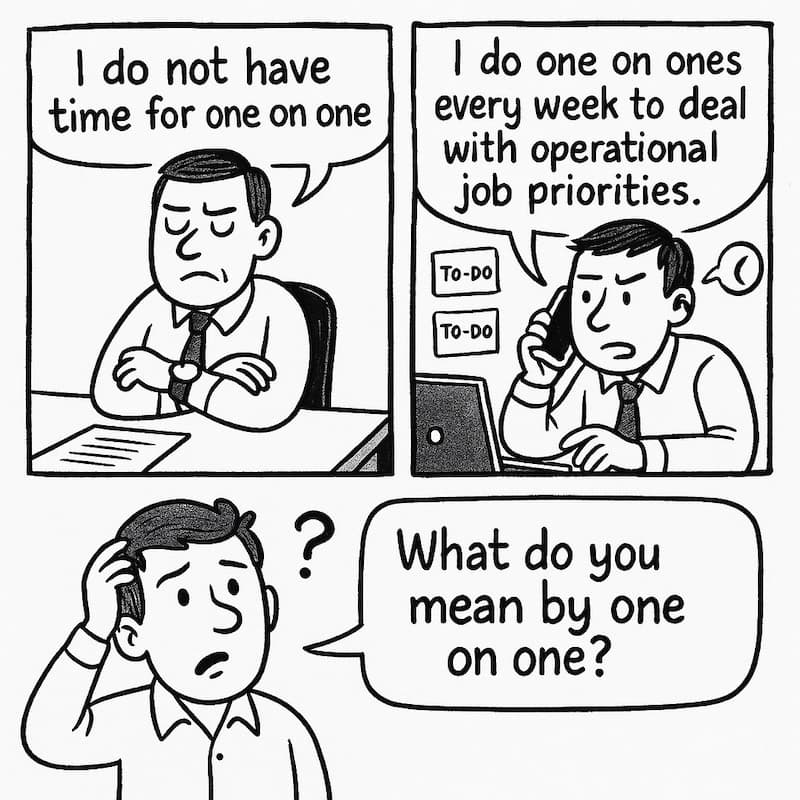
One on one Structure That Works
| Time | Focus | Questions to Ask |
| 5 min | Personal check-in | “How are things?” “Anything outside work affecting focus?” |
| 10 min | Performance Progress & feedback | “What went well this week?” “What’s stuck?” – Giving feedback on performance |
| 10 min | Development progress & Feedback | “Where are we from the development plan” |
| 5 min | Feedback for yourself | “What can I do better to support the delivery of our performance and / or development objectives”? |
| 5 min | Wrap-up | “What will you do before our next meeting?” |
Important : Document 2-3 bullet points each time. Follow up next week. Consistency builds credibility.
From Manager to Coach
Coaching isn’t therapy or motivational speeches. You’re not giving answers, you’re unlocking them. Don’t fall in the trap of telling what to do.
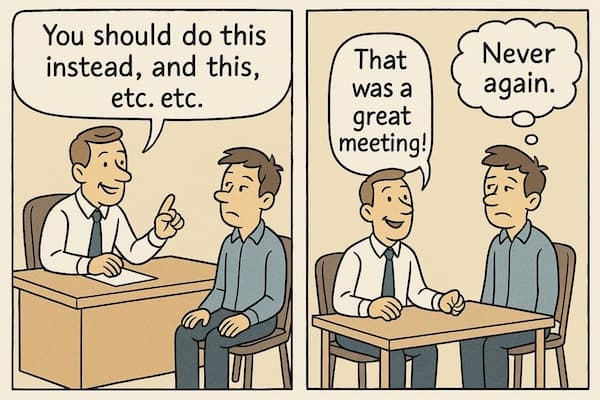
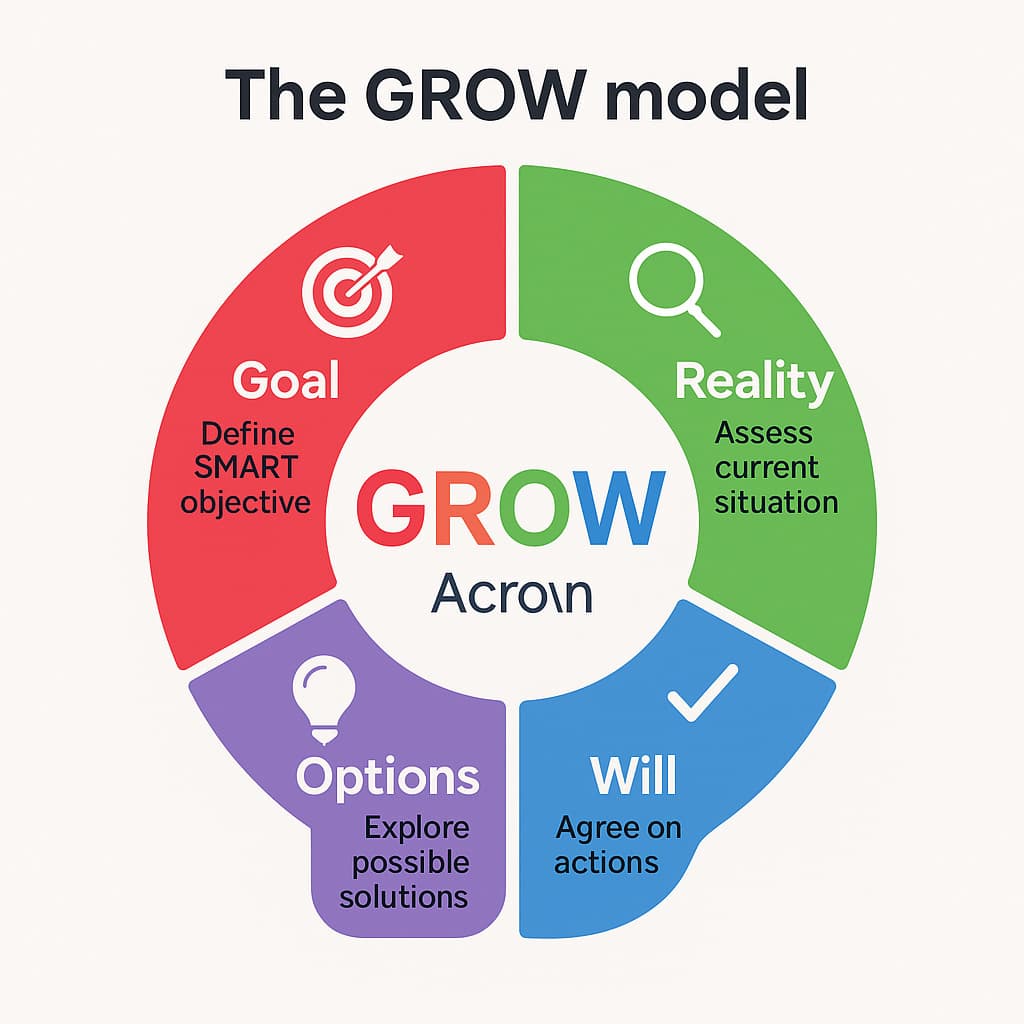
Instead, put your coach hat on and ask questions that make people think. Use the GROW coaching model for that:
- Goal: “What do you want to achieve?”
- Reality: “What’s happening now?”
- Options: “What could you try?”
- Way forward: “What will you do next?”
Monday-Morning Test: Integrate coaching in your 1-1s. You are switching to your coaching hat when it comes to the development plan conversation. It means to identify a set of competency and skills your subordinate needs to develop, which requires coaching to help them grow.
6. Delegation and Trust: Stop Micromanaging
Why New Managers Struggle to Let Go
Delegation feels risky. You think, “I can do it faster myself.”
You can but that’s not the point. Your job now is to scale outcomes through others.
Refusing to delegate teaches two things:
- You don’t trust your team.
- They shouldn’t make decisions without you.
Both kill initiative.
Delegate Like a Pro
- Define the outcome, not the process.
“Deliver a 2-page summary for the board by Friday,” not “Use this template, this font, and CC me on every draft.” - Give context.
Explain why the task matters, people perform better when they see impact. - Check understanding.
Ask them to restate deliverables in their own words. - Set milestones, not micromanagement.
“Let’s check progress Wednesday,” instead of daily messages. - Celebrate completion, debrief mistakes.
Use every task as a learning loop.
Delegation Matrix for new managers
| Task Type | Keep | Delegate | Automate / Eliminate |
| Strategic planning | ✅ | ||
| Routine reporting | ✅ | ||
| Admin follow-ups | ✅ | ✅ | |
| Low-value meetings | ✅ |
Monday-Morning Test: List everything on your to-do list. Circle one task that someone on your team could own. Hand it off today, even if imperfectly.
7. Building a Performance System That Keeps You Sane
Performance management sounds bureaucratic, but it’s just a rhythm of clarity and follow-up.
The Three Systems You Need Running
- Goals → Alignment
Everyone knows what success looks like. - Feedback → Improvement
Issues addressed fast, not stored for annual reviews. - Check-ins → Accountability
Data reviewed, progress discussed, next steps set.
If you’re missing one, you loose track and your team will loose focus (and so will you). Ensure you set a rhythm that works.
Running a Performance Conversation
Forget the scripted corporate forms. Use this 15-minute structure:
- Review outcomes: “Our goal was X; we achieved Y.”
- Discuss behaviors: “What helped?” “What got in the way?”
- Agree on adjustments: “What do you suggest to improve”
- Document key points: one email summary, no novel needed.
Make it routine, not dramatic.
Simple KPI Dashboard
| Area | Metric | Target | Owner |
| Customer response time | Hours to first reply | ≤ 24 h | Ops Lead |
| Project delivery | On-time completion rate | ≥ 95 % | Project Mgr |
| Engagement | Team satisfaction pulse | ≥ 8 / 10 | All |
Share progress on every one on ones. Transparency drives accountability.
Monday-Morning Test:
Pick 3 metrics you can track monthly. Start plotting them today, even a simple spreadsheet if your company does not have a clear performance management system in place.
8. Managing Up and Sideways: How New Managers Influence Without Authority
Great managers don’t just manage people; they manage context. Half your success depends on how well you align with your boss and peers.
How to Manage Up
Your boss hates surprises. Keep them informed, not overloaded.
Use a weekly or monthly update rhythm depending on your company’s culture:
Three-line email formula:
- Here’s what’s working.
- Here’s where we’re off track.
- Here’s what I need from you.
It shows ownership and maturity. What you are doing from your team, have your boss do it for you as well. Some managers often tells me “but my boss is not doing it for me”. That is no excuse. If you expect people to do things for you, you will not go far. You will remain trapped in a system that may or may not work. Ensure you have a plan to also proactively manage expectations from your management.
When giving bad news, deliver it early and with a plan.
“We’re two weeks behind. I’m reallocating resources and will recover half the delay. I’ll update next Friday.”
You prefer them to remember your control, not the delay.
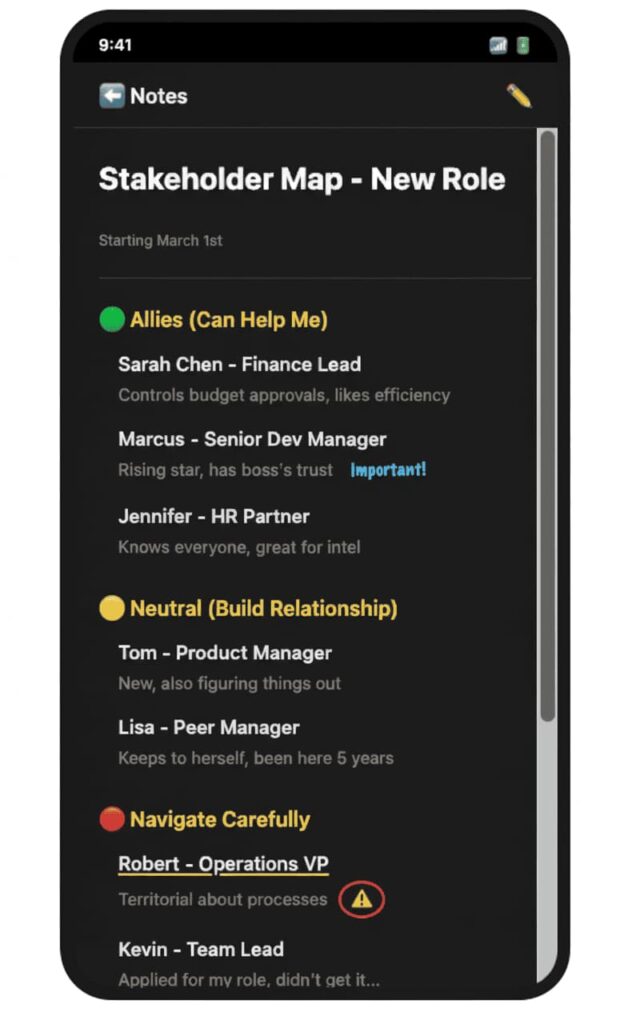
How to Manage Sideways
Your peers can make or break your initiatives. We often under-estimate this part. Ensure you use some of your lobbying power progressively across the company : Invest in trust before you need favors.
Practical moves:
- Attend one cross-department meeting each month.
- Praise publicly when another team helps yours.
- Share resources instead of hoarding credit.
Build allies, not bureaucratic rivals.
Monday-Morning Test:
Identify the stakeholders that have some influence in the delivery of your team’s or department’s success. Meet them frequently over coffee to build trust and ensure you are aligned on roadblocks or common deliverables. Being a manager also means to manage influences sideways.
9. Managing Yourself: How Consistency Beats Charisma for Every New Manager
You can’t lead if you’re depleted.
Every new manager eventually learns the hard way that time and energy are finite resources.
Create Your Weekly Rhythm
Structure breeds sanity. My best advice is to manage with your calendar and ensure the time reparation in terms of what you delegate, your time being in front of the right priorities and also for individual outputs. Again, double check your individual output to ensure you are not working on tasks that could be delegated. As a manager, you may decide to allocate time on building / fixing processes handling tasks your subordinates are supposed to work on.
Get actionable insights for your first 90 days as a new manager.
Set Boundaries Early: If you answer emails at 11 p.m. in week one, it becomes normal forever.
Clarify with your team your work standards:
- Working hours
- Response-time expectations
- What counts as an emergency
Communicate it clearly and stick to it.
Find Your Support System
Even seasoned leaders need a sounding board.
Seek mentors, peers, or communities where you can vent and learn.
If your company doesn’t provide one, build your own network: manager circles, or structured programs like my Manager Development Program.
Monday-Morning Test:
Block one hour of “manager time” in your calendar this week. Guard it. Use it for thinking, not doing.
10. The New Manager Growth Roadmap
When you have built the basics : direction, feedback, systems, rhythm. Now comes the long game: becoming the kind of manager people want to follow, not just have to.
Leadership is not a title; it’s a series of upgraded behaviors. The difference between mediocre and great managers isn’t raw talent, it’s how intentionally they keep improving.
Learn about the difference between leader and manager. Now let’s unpack how you build yourself as a manager in practice.
Step 1: Audit Your manager skills
Most new managers overestimate what they know. The sooner you identify your blind spots, the faster you grow.
Ask yourself:
- Have I ever fired someone respectfully and cleanly?
- Can I confidently handle a defensive or tearful feedback reaction?
- Do I know how to set SMART goals without HR templates?
- Can I have a career conversation that inspires someone to stay?
- Do I actually coach, or do I just give advice and call it coaching?
If the answer to these is “not really” congratulations you are only human. Management is a practice, not an innate skillset.
Start by mapping your confidence levels from 1 (not confident) to 5 (very confident) across five core areas:
Goal setting – Feedback – Coaching – Performance systems – Self-management.
Then, prioritize learning one area per quarter.
Monday-Morning Test: Pick one competency you’re weakest in. Block time this week to learn, read, or watch something practical about it. If you need training support, here are the modules included in my manager development program :
- Module 1: People management training
- Module 2: Goal setting for managers
- Module 3: Team development training
- Module 4: Coaching for managers
- Module 5: Performance management for managers
- Module 6: Recruitment in practice
Step 2: Create Your Personal Development System
You can’t wait for HR to develop you. Most HR teams are already drowning in compliance training and administrative tasks. You can either ask HR or enroll yourself in a short and practical new manager training to develop your personal management system.
Your system doesn’t have to be fancy, just consistent.
Your Manager Development Routine
- Monthly reflection: What worked, what didn’t, what I’ll do differently next month.
- Quarterly peer check-in: One conversation with another manager about your biggest challenge.
- Yearly reset: Update your leadership goals and refresh your tools.
Tools you can use:
- Journal or Notion template for reflections
- Calendar reminders for peer check-ins
- Templates from your Manager Development Program for goals and feedback tracking
Step 3: Manage Your Career Like You Manage Your Team
Being a good new manager doesn’t guarantee recognition. You need to make your value visible without bragging.
Practical strategies:
- Keep a “Wins Log” short bullets of results achieved, issues solved, people developed.
- Share updates upward every month (“Here’s what the team delivered”).
- Volunteer for cross-department projects that show strategic impact.
Step 4: Learn to Balance Empathy and Accountability
One of the hardest balances for new managers is being kind without becoming soft.
You care about people but you also have to hit results.
Simple rule:
“Empathy means I understand your situation. Accountability means I still expect results.”
Use both in the same conversation:
“I know this project hit unexpected roadblocks (empathy). But we still need to deliver by Q1. What support do you need to make that happen? (accountability).”
That tone is firm but fair. Ensure that respect is earned.
Monday-Morning Test:
Think of one team member who’s missing deadlines. Write a script that balances empathy and accountability using the FIAC framework. Then use it in your next conversation.
Step 5: Prepare for Your Next Level
Eventually, your role will evolve again from managing people to managing managers. That requires another upgrade: moving from control → culture.
At that level, your job isn’t to know every detail. It’s to ensure your managers:
- Know how to run feedback loops.
- Maintain team health metrics.
- Model consistent behavior.
You basically need to train them on the skills you are learning yourself. Even as you grow, the fundamentals from this guide remain the foundation.
11. The Systems That Make You a Great New Manager
Let’s zoom out. Management isn’t luck or personality it’s systems you maintain every week.
Your Core Management System Should Include:
- Clear goals your team understands.
- Feedback rhythm that’s consistent and constructive.
- Coaching time to develop skills and independence.
- Performance visibility through simple metrics.
- Upward and cross-functional alignment to protect your team from chaos.
- Self-management to keep you grounded and credible.
Review your new manager checklist.
If these systems are running, you’ll deliver performance even during messy quarters.
12. The Truth Nobody Tells You About Management
The higher you go, the lonelier it feels.
You’ll spend more time listening than speaking, more time resolving tension than celebrating wins.
You’ll have to be the calmest person in the room even when you feel lost inside.
That’s management. It’s not about power it’s about service.
But it’s also the most rewarding role in business. Because when you see someone grow, take ownership, and succeed because you gave them the space to, that impact that lasts beyond any metric.
You don’t need to be perfect.
You need to be consistent, fair, and human.
13. The Best Managers Are Made on Monday Morning
Management isn’t about titles, inspirational quotes, or coffee mugs that say Boss Mode.
It’s about clarity, consistency, and courage.
Explore my manager development program
5 Complete Modules: Introduction to People Management, Goal Setting, Competency Development, Coaching & 1-on-1s, Performance Management in Practice.
If you’re reading this, you’ve already done the hardest part: you care enough to learn.
Now make it count.
Because the best new managers aren’t born confident they build confidence one clear conversation, one delegated task, and one Monday at a time.
“The best managers aren’t made in training rooms. They are made on Monday morning.”
MORE MANAGER DEVELOPMENT RESOURCES
This article is part of our manager development resources.
Stay sharp for Monday
Practical resources to help managers lead smarter, faster, and with confidence.

Free manager resources for new Managers
View Article
New Manager Tips: What to Do BEFORE You Step Into the Job
View Article